

140 Miles, £46 Billion, and Not a Single Train
140 Miles, £46 Billion, and Not a Single Train
In April 2008, China broke ground on the Beijing to Shanghai high-speed railway. The line runs 1,318 kilometres through six provinces, crosses 244 bridges and 22 tunnels, and connects two of the largest economic zones on Earth. It opened to the public on 30 June 2011, thirty-eight months after construction began. Total cost: 220.9 billion yuan, approximately $32.5 billion at the time. It now carries over 210 million passengers per year and has been profitable since 2014.
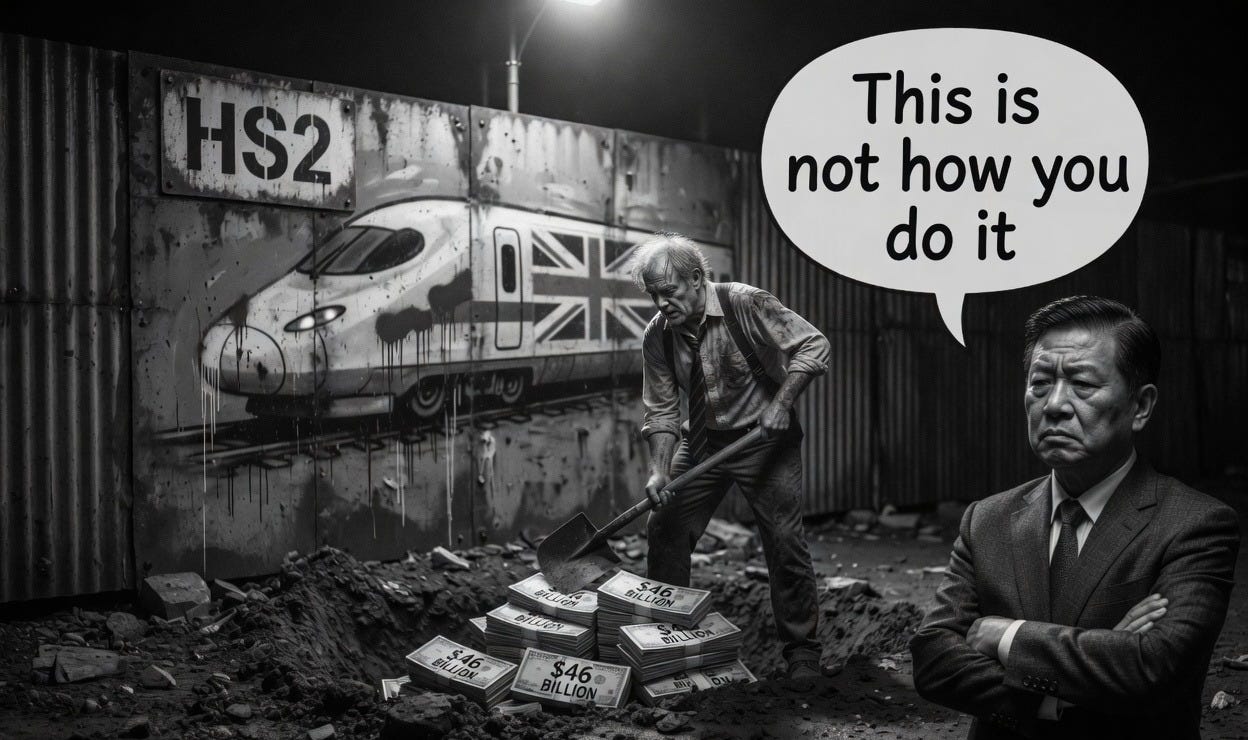
In the same month that China broke ground on Beijing to Shanghai, the United Kingdom was still arguing about whether HS2 should exist. Construction did not begin until 2020. The route covers 140 miles of new track between London and Birmingham. As of February 2026, £46.2 billion has been spent. No track has been laid. No train has run. No opening date has been confirmed. The government’s own Transport Secretary, standing in Parliament in June 2025, described the situation as “an appalling mess” characterised by “spiralling costs, ineffective oversight and broken promises.”
Those words came from the government’s own Transport Secretary, delivered to the House of Commons, on the record.
The Numbers Side by Side
Beijing to Shanghai: 1,318 kilometres of operational high-speed railway, built in 38 months, for $32.5 billion. Trains running at 350 kilometres per hour. Over 400,000 daily passengers. Profitable within three years of opening.
HS2 Phase 1: 225 kilometres of proposed high-speed railway, under construction since 2020, with £46.2 billion already spent and no firm completion date. Civil engineering roughly halfway done. Earthworks at 70 per cent. Two out of 52 viaducts complete. Nineteen out of 169 bridges finished. Not a metre of operational track.
China built a line nearly six times longer, in a third of the time, for less money. And it was not an outlier. It was one line among thousands. By the end of 2025, China’s high-speed rail network exceeded 50,000 kilometres, more than every other country on Earth combined. That network grew from 37,900 kilometres to 50,400 kilometres in the five-year period from 2021 to 2025 alone, an increase of 12,500 kilometres. The UK, in roughly the same period, managed to spend £46 billion without completing a single functioning section.
Where the Money Went
The James Stewart Review, published in June 2025, set out what went wrong. The findings, even partially redacted for commercial reasons, read like an indictment. Costs on main construction contracts were identified as “by far” the principal driver of overruns. HS2 Ltd could not produce reliable cost or schedule estimates. Contractors operated under cost-plus arrangements that transferred nearly all financial risk to the taxpayer while guaranteeing their own margins.
The scale of contractor payments tells its own story. A Sunday Times analysis of payments through mid-2025 found that Balfour Beatty and Vinci each received over £5 billion. Kier received £2.4 billion. Eiffage received £2.3 billion. Thirteen firms each collected more than £1 billion. One joint venture between Balfour Beatty and Vinci took approximately £9 billion for a single section. The Big Four accountancy firms billed £292 million in consulting fees. Legal advisers collected £67 million. Public relations and stakeholder engagement cost £50 million.
The former CEO of HS2 Ltd, Mark Thurston, earned over £4.5 million during his tenure, with annual packages between £585,000 and £676,000, making him one of the highest-paid figures in the UK public sector. Fraud was also detected. A 2025 investigation found that labour suppliers on the West Midlands section had been billing inflated rates. One supplier, Danny Sullivan Group, had its contract terminated.
Meanwhile, failed Euston station designs consumed a quarter of a billion pounds before being written off entirely. When HS2 Ltd was asked to produce a cheaper design, it came back with one costing £400 million more than the original.
What China Did Differently
The comparison requires no sophistication. China made a decision, funded it, and built it. The decision-making sat with centralised authority. Land acquisition was state-directed. Construction contracts were awarded domestically and managed against delivery targets, not cost-plus reimbursement schedules. Workers numbered over 130,000 at peak on the Beijing to Shanghai line alone. HS2 employs around 34,000 across the entire programme.
China’s investment in railway fixed assets reached 850.6 billion yuan in 2024, an 11.3 per cent increase year on year. The country carried 4.08 billion passenger trips by rail in 2024. It is now testing the CR450, a next-generation train that hit 453 kilometres per hour in trials, with a relative passing speed of 896 kilometres per hour recorded on the Chengdu to Shanghai line. The target for 2030 is 60,000 kilometres of operational high-speed rail. The target for 2035 is 70,000 kilometres.
The technology was available to anyone. China’s early high-speed trains were based on imported designs from Siemens, Bombardier, and Japanese manufacturers. The gap between the two countries has nothing to do with engineering capability. It comes down to governance, will, and contract structure.
The Structural Failure
HS2 failed as a procurement exercise, a governance exercise, and a political exercise. The construction workers did their jobs. Everyone above them did not. And nobody has been held to account in over a decade.
The original estimate in 2012 was approximately £20 billion for the full network. Phase 1 alone is now projected to cost between £67 billion and £83 billion, with some forecasts pointing toward £100 billion. The northern sections to Manchester and Leeds were cancelled entirely. What remains is 140 miles of railway between London and Birmingham that has absorbed more public money than the entire Beijing to Shanghai line.
The Stewart Review identified five structural failures: absent ministerial oversight, no effective cost control, poorly designed contracts with misaligned incentives, inadequate governance structures, and unreliable reporting from HS2 Ltd to government. Mark Wild, the incoming CEO, confirmed that the project’s cost, schedule, and scope were “unsustainable” and that HS2 Ltd itself did not possess an accurate assessment of how much work had been completed or how much remained.
The Department for Transport and HS2 Ltd still do not agree on how much the project will cost to finish. That sentence alone should end careers.
The Pattern: Every UK Megaproject, Matched Against China
HS2 would be easier to forgive if it were an outlier. It is the pattern. Only 14 per cent of the UK government’s strategic projects and programmes remain on track to deliver expected objectives. In August 2025, the government’s own infrastructure authority rated £89 billion worth of projects as “unachievable.” Place every major UK infrastructure failure of the last 25 years on a timeline, then look at what China completed in the same window. The contrast tells you everything about who can govern and who cannot.
Edinburgh Trams (2008 to 2014). The UK budgeted £545 million for 18.5 kilometres of tramway. It opened three years late, eight stops short of its destination, at a true cost of £835 million. A public inquiry found “a litany of avoidable failures” and took nine years to publish its findings. In the same six years, China built the Beijing to Shanghai high-speed railway (1,318 km, 38 months, $32.5 billion), opened the Wuhan to Guangzhou HSR (1,069 km), and grew its high-speed network from near zero to 10,000 kilometres, exceeding the entire European Union. Edinburgh could not lay 18.5 kilometres of tram track. China laid ten thousand kilometres of high-speed rail.
Crossrail (2009 to 2022). The UK spent 13 years and £18.8 billion to build 21 kilometres of new tunnel under London. It opened four years late. A Parliamentary committee found that Crossrail Ltd failed to manage contractors, failed to understand the complexity of its own programme, and continued paying executive bonuses throughout. In the same 13 years, China grew its high-speed rail network from 649 kilometres to 37,900 kilometres. It built and opened Beijing Daxing International Airport, the world’s largest single-building terminal, 700,000 square metres, constructed in under five years for $17 billion, with high-speed rail running underneath. It completed the Hong Kong-Zhuhai-Macau Bridge, the world’s longest sea crossing at 55 kilometres. While the UK dug 21 kilometres of tunnel, China built 37,000 kilometres of railway, the world’s largest airport, and the world’s longest bridge.
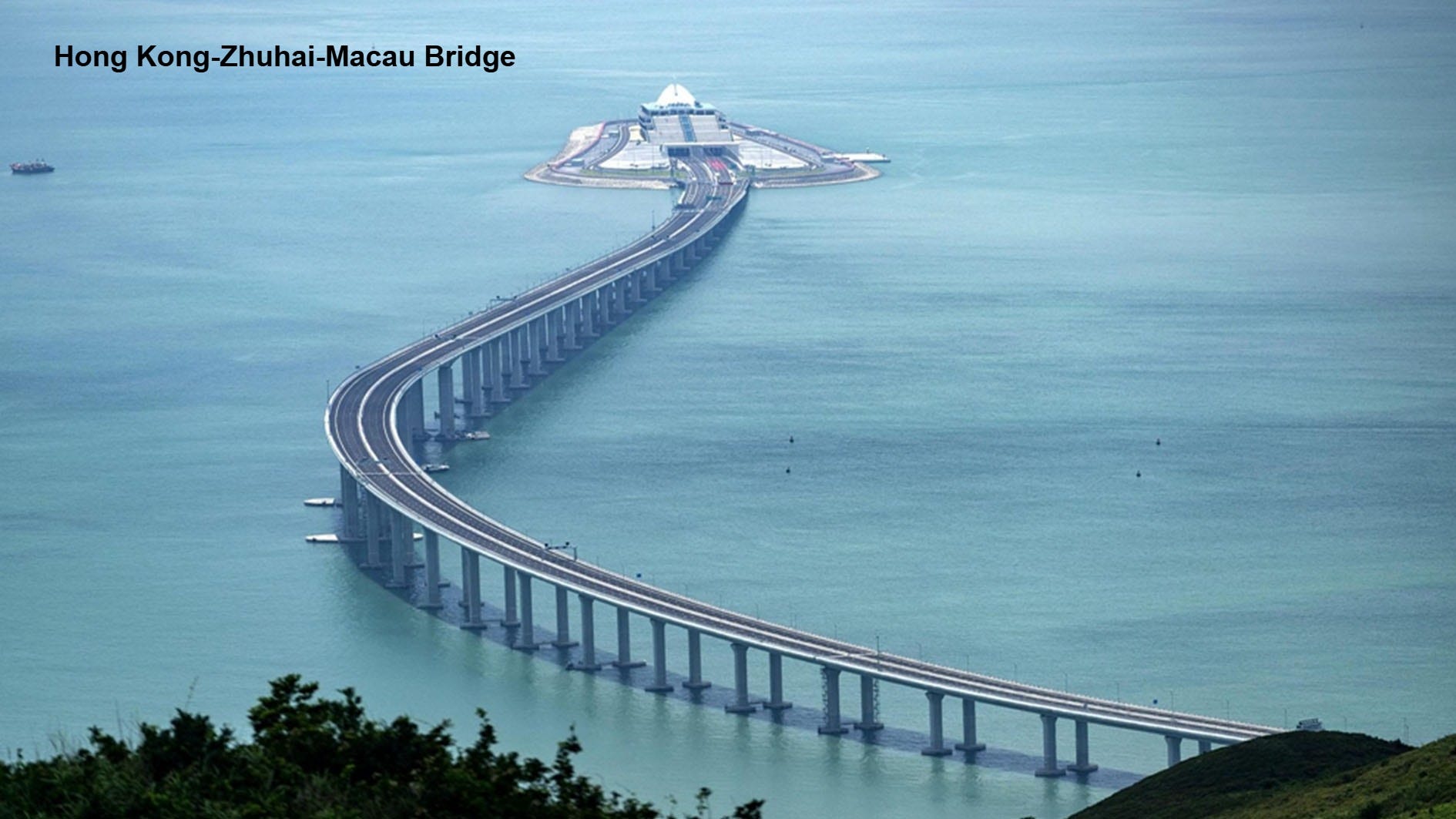
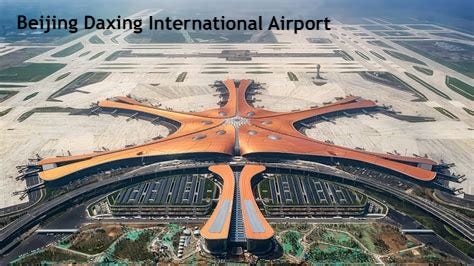
Hinkley Point C (2016 to present). The UK approved one nuclear power station at £18 billion. Nine years later, no electricity has been generated. The projected cost has nearly doubled to £35 billion in 2015 prices, approximately £48 billion in current terms. Completion has been pushed to 2030 at the earliest. A government report found the UK to be “the most expensive place in the world” to build nuclear power. In the same period, China brought multiple Hualong One reactors into commercial operation, added 12,500 kilometres of high-speed rail, opened Daxing Airport, and completed the Shenzhen-Zhongshan Link, a 24-kilometre crossing with two suspension bridges, two artificial islands, and a submerged tunnel. In 2025 alone, China invested 901.5 billion yuan in railways and opened 3,109 kilometres of new track.
The Scottish Parliament Building (1999 to 2004). Estimated at £40 million. Delivered at £414 million. A 900 per cent cost overrun and 42 months late, for a single building. In the same period, China completed the first generators of the Three Gorges Dam, built the Qinhuangdao to Shenyang HSR, and expanded its expressway network by 18,000 kilometres.
These are not cherry-picked comparisons. They are every major UK infrastructure project of the last quarter century, placed alongside the documented record of a country that decided to build and then built. The UK record across 25 years of megaprojects produces the same result every time: late, over budget, reduced in scope, investigated, and reset. China’s record across the same period is 50,000 kilometres of high-speed rail, the world’s largest airport, the world’s longest sea crossing, and a nuclear build programme that delivers reactors faster than the UK can produce a revised cost estimate.
What This Tells You
The word for what China demonstrated across these decades is statecraft. Serious operational planning. A completion date set before ground is broken. Unity of purpose from leadership to site worker. An institutional culture that treats finishing what you started as a matter of national honour. No contractor starts a project without knowing when the practical completion day will come, because somebody in authority decided that date before a single pile was driven.
Western media brands this governance as totalitarianism. The word serves a purpose. It deflects attention from the visible, measurable collapse of countries that brand themselves as democracies. The United Kingdom, the European Union, and Ireland are in a spiralling descent, led by politicians who cannot name a single major infrastructure project delivered on time and on budget in the last twenty years. There are no confident leaders making good decisions. There are committees, consultations, scope changes, cost-plus contracts, and press releases announcing the next reset of the last reset.
Democracy, in its current Western form, has produced more corruption per pound of public spending than the systems it lectures. HS2 consumed £46 billion and delivered nothing operational. Hinkley Point C doubled its budget without generating a watt. Crossrail took 13 years for 21 kilometres. Edinburgh could not build a tram line. The Scottish Parliament could not build a parliament. Contractors wrote their own terms. Oversight bodies failed to meet. Fraud was found in the supply chain. A quarter of a billion pounds was spent on station designs that were thrown away. And 86 per cent of current government projects are off track.
Meanwhile, China connects 97 per cent of its cities with populations over 500,000 by high-speed rail, tests trains at 453 kilometres per hour, and plans to reach 70,000 kilometres of operational track by 2035. The infrastructure speaks for itself. Beautiful stations. Functioning networks. Trains that arrive on time. Projects that finish when the government said they would finish.
The countries that call this authoritarianism should look at their own record before reaching for the label. A country that spends £46 billion and cannot lay a single rail has no standing to lecture any nation on how to govern.
Did the IRS ever ask where those tax dollars went?
Or do they only ask questions to the tax payers?
Once again, another well researched and written article from WAR. Exposing the incompetent the corrupt and the ugly. The historic failures of UK governments to deliver on public construction enterprises/projects is truly appalling. The UK gov is an embarrassment to it's people, on all levels in all sectors across all platforms.