

When Ancient Wisdom Meets Digital Democracy
In the pre-dawn darkness of Varanasi, where the Ganges receives the prayers of millions, something unprecedented unfolds. The same river that carried the wisdom of ages now flows through fiber optic cables, connecting villages to global markets. 27 international awards spanning every continent. 185 billion digital transactions flowing through systems that barely existed eight years ago. 171 million people lifted from extreme poverty in a single decade.
These numbers, vast as the subcontinent itself, tell only part of a story that began five millennia ago and reaches its crescendo in our digital age. Prime Minister Narendra Modi has orchestrated what scholars will study for generations: a civilizational renaissance that proves ancient dharma and cutting-edge technology can create symphonic harmony when guided by visionary leadership rooted in cultural understanding.
From the bustling streets of Mumbai to the remote villages of Odisha, India
awakens.
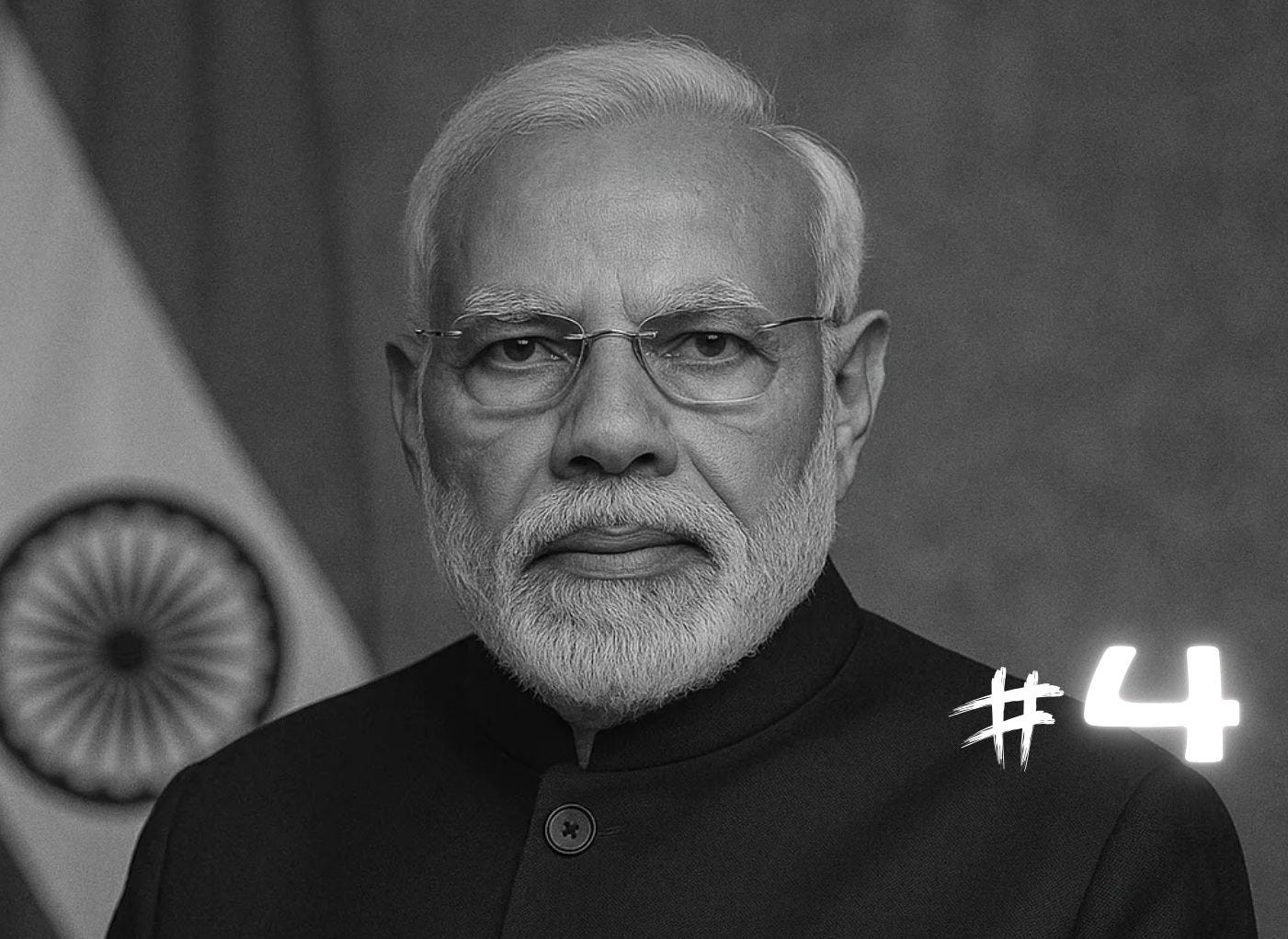
Subscribe to access this and 16 other detailed reports on the 17 great leaders that surpassed the leadership benchmark test.
संकल्प से सिद्धि - From Resolution to Achievement
The morning begins in a small village in Rajasthan where Meera Devi opens her mobile phone. Three taps later, she transfers money to her daughter studying in Delhi—a transaction that would have required a day-long journey to the nearest bank just five years ago. This is governance as seva, service transformed into digital dharma.
Modi's approval ratings of 75% among global leaders rest not on manufactured consent but on millions of such transformations. Pew Research confirms 79% favorable views from citizens who experience government as enabler rather than obstacle. These figures gain meaning through lived experience: the farmer who sells crops directly to processors via eNAM platforms, the entrepreneur who starts a business in 18 days instead of 18 months, the student who accesses world-class education through digital infrastructure.
Democracy's ancient challenge, balancing popular will with effective governance, finds resolution through what sage-kings of old called raj dharma. Righteous rule manifests through measurable outcomes rather than mere rhetoric. Three consecutive electoral mandates spanning a decade demonstrate sustained trust earned through delivery.
The sovereignty equation, so puzzling to Western analysts, operates through civilizational understanding. India under Modi has achieved strategic autonomy that strengthens rather than weakens international relationships, maintaining bonds with Russia while deepening ties with America, engaging China while leading the Global South, hosting the G20 while championing developing world priorities.
When twenty Indian soldiers died at Galwan, the first casualties in 45 years, pressure mounted for military response. Modi chose the path of strategic patience, ultimately securing Chinese withdrawal through October 2024 border agreements. This choice reflects not weakness but the strength that comes from long-term vision over short-term emotion.
Digital Ganges - Sacred Flow of Technology
Rivers in Indian philosophy carry both water and consciousness. The Unified Payments Interface has become India's digital Ganges, flowing with 185 billion transactions annually, a 425-fold increase since 2017. Yet this transformation transcends mere efficiency; it represents technology as dharmic practice, serving universal access and dignity.
Jan Dhan Yojana exemplifies this philosophical approach. Bank account access rose from 42% to 96.3% not through traditional branch expansion but by recognizing that technology can leapfrog historical constraints. Direct Benefit Transfers now channel welfare payments with mathematical precision, eliminating the corruption that historically consumed 30-40% of intended benefits.
Aadhaar's 1.38 billion unique digital identities represent more than administrative efficiency, they constitute recognition of each citizen's inherent dignity and right to participation. DigiLocker's 370 million users access official documents instantly, transforming bureaucratic humiliation into empowered citizenship.
The International Monetary Fund recently labeled India's Digital Public Infrastructure "world-class," urging other nations to learn from the model. Thirty countries now implement UPI-style systems, with France becoming the latest adopter. This represents civilizational influence achieved through practical philosophy rather than cultural imposition.
Ancient texts speak of knowledge as light dispelling darkness. Modern India demonstrates this principle through digital infrastructure that illuminates previously shadowed corners of economic life, connecting remote villages to global opportunities. The merchant in Kerala's backwaters and the artisan in Punjab's villages now participate in the same digital economy as Mumbai's financial district.
महान कार्य - The Great Work of Infrastructure
Infrastructure in the Indian context carries deeper meaning than mere construction. The rishis understood that external order reflects internal harmony; Modi's infrastructure philosophy manifests this principle through systematic transformation that honors both utility and aesthetics, efficiency and meaning.
PM Gati Shakti National Master Plan represents this understanding in action. The $1.2 trillion investment integrates 1,650 data sources across ministries, reducing logistics costs from 14-16% of GDP toward a target of 9%. This level of coordination would challenge any democracy; achieving it while maintaining federal structures demonstrates sophisticated systems thinking.
Bharatmala Pariyojana's 34,800 kilometers of national highways, 96% operational as of 2025, ensures that geography no longer determines opportunity. The employment impact touches virtually every Indian family: 450 million direct work-days and 570 million indirect. This represents economic democracy made manifest through patient investment.
Rail transformation deserves particular attention. 94% network electrification achieved under Modi, compared to decades of incremental progress previously. 100 Vande Bharat high-speed trains now operational serve as symbols of indigenous technological capability. Metro systems expanded 4x, serving 21 cities through urban mobility reimagined.
Airport expansion tells a similar story: 84 operational airports with plans for 120 more, potentially serving 40 million additional passengers. The calculated liberation from geographical constraints that historically limited Indian potential unfolds through methodical infrastructure meditation.
Cyclical wisdom becomes apparent: quality infrastructure enables economic activity, which generates revenues for more infrastructure, creating virtuous cycles of development that compound across generations.
गरीबी मुक्ति - Liberation from Want
The most extraordinary statistic in contemporary global development belongs to India: 171 million people lifted from extreme poverty between 2011-2023. This figure represents more than the combined populations of Germany and the United Kingdom achieving economic liberation in a single decade.
World Bank data confirms the transformation: extreme poverty declined from 16.2% to 2.3%, with rural poverty dropping from 18.4% to 2.8%. SBI Research shows overall poverty below 5% in 2024, a threshold placing India among middle-income nations despite complex demographic challenges.
These numbers represent individual stories of transformation multiplied by hundreds of millions. The Jan Dhan-Aadhaar-Mobile trinity enabled precise targeting of welfare benefits, ensuring assistance reaches intended recipients rather than disappearing into bureaucratic channels.
Modi's approach transcends traditional poverty alleviation. The Multidimensional Poverty Index decreased from 53.8% to 16.4%, indicating improvements across health, education, and living standards—not merely income. This reflects philosophical understanding that poverty encompasses more than material deprivation; it includes dignity, opportunity, and social participation.
Direct Benefit Transfer systems now channel payments worth trillions of rupees annually, but their deeper significance lies in transforming the relationship between citizen and state. Previously, the poor were supplicants. Now, they are rightsholders with digital identities and bank accounts, able to receive benefits directly without intermediary corruption or humiliation.
The UN's Champions of the Earth Award acknowledged Modi's climate leadership while multiple nations study India's poverty reduction methodologies. The Voice of Global South Summit, hosted for the third time in August 2024 with 173 dignitaries from 123 countries, positions India as champion of developing world aspirations.
विश्व गुरु - The Teacher of Nations
In diplomatic history, few leaders earn recognition spanning every inhabited continent. Modi's 27 international awards constitute objective validation of transformational leadership from diverse cultural and political perspectives.
Recent honours tell their own story. Namibia's Order of the Most Ancient Welwitschia Mirabilis. Brazil's Grand Collar of the National Order of the Southern Cross. Russia's Order of St. Andrew the Apostle, the highest civilian honour, granted to Modi as the first Indian recipient. Nigeria's Grand Commander of the Order of the Niger, previously awarded only to Queen Elizabeth II among foreign dignitaries.
Trinidad and Tobago made Modi the first foreign leader to receive their Order of the Republic. Cyprus honored him with the Grand Cross of the Order of Makarios III. Ghana, Kuwait, and Bhutan followed with their highest civilian recognitions, each representing diplomatic relationships deepened through personal engagement and mutual respect.
The geographical distribution reveals strategic depth. Asian nations recognize economic partnership. African countries acknowledge South-South cooperation. European awards reflect democratic solidarity. Caribbean and South American honors indicate expanding influence beyond traditional spheres.
Contemporary diplomacy reveals Modi's synthesis of ancient Indian concepts with modern statecraft. Vasudhaiva Kutumbakam, "the world is one family", transforms from philosophical poetry into practical policy framework. India's humanitarian assistance during crises, from earthquake relief to pandemic support, demonstrates this principle in action.
The G20 presidency exemplified this transformation, with Modi successfully securing African Union membership and hosting productive summits that advanced developing world priorities. The International Solar Alliance, originally Modi's initiative, now includes 121 countries committed to renewable energy expansion.
Twenty-seven awards from twenty-seven different value systems, yet unified appreciation for transformational achievement that serves both national development and global stability.
संकट से सामर्थ्य - Strength Through Crisis
The ultimate test of leadership arrives through crisis, moments when conventional approaches fail and innovative thinking becomes essential for survival. Modi's decade demonstrates consistent ability to transform challenges into catalysts for systematic improvement.
COVID-19 provided perhaps the greatest test. While critics rightfully noted failures during the devastating second wave, the broader response reveals strategic thinking under pressure. A $240 billion economic relief package (10% of GDP) represented the largest stimulus in Indian history, cushioning economic impact while maintaining fiscal stability.
CoWIN, the digital vaccination platform, processed over 2 billion doses efficiently, becoming a model for global health infrastructure. Early lockdown decisions, while economically painful, bought crucial time for healthcare preparation. International cooperation during crisis, providing medical aid to China, establishing SAARC COVID funds, demonstrated leadership beyond national boundaries.
5.8% GDP contraction in FY21 might suggest policy failure, yet rapid recovery to 8.2% growth in FY24 indicates successful crisis management. Employment data shows the economy outpaced working-age population growth from 2021-22 onward, suggesting structural improvements rather than mere statistical recovery.
Border management reveals similar resilience patterns. The Galwan clash resulted in the first military casualties in 45 years, yet Modi chose de-escalation over popular demands for retaliation. Strategic patience ultimately yielded the October 2024 disengagement agreement, restoring border stability while strengthening India's negotiating position.
Natural disaster response showcases systematic crisis preparedness. Cyclone management now involves zero-casualty protocols through early warning systems and coordinated evacuation procedures. The Coalition for Disaster Resilient Infrastructure, Modi's global initiative, helps vulnerable nations build climate-adaptive systems.
Financial crises receive similar treatment. The 2016 demonetization, while controversial, accelerated digital payment adoption and formalized previously cash-based economic activity. Banking sector reforms following the NPA crisis strengthened institutional resilience for future challenges.
What distinguishes Modi's crisis management is philosophical orientation: viewing disruption as opportunity for systematic improvement rather than temporary inconvenience to be endured.
भारत की भूमिका - India's Global Role
International recognition validates domestic achievement through external perspective. When the IMF praises India's Digital Public Infrastructure as world-class and urges other nations to adopt similar systems, it confirms that local innovations possess global relevance.
Economic transformation speaks through comparative metrics. India's 6.5% projected growth (IMF 2024) substantially exceeds China's 4.6%, suggesting sustainable development models that maintain democratic structures. Manufacturing growth of 9.9% in 2023-24 indicates successful diversification beyond traditional service sector strengths.
The Ease of Doing Business improvement—from 142nd to 63rd position representing the largest improvement by any nation—reflects systematic regulatory reform benefiting both domestic entrepreneurs and international investors. Production-linked incentive schemes worth $24 billion have attracted global manufacturing, positioning India as alternative to China-dependent supply chains.
Strategic autonomy achievements gain recognition through practical results. India's position during the Russia-Ukraine conflict, maintaining relationships with all parties while pursuing national interests, demonstrates sophisticated diplomacy that major powers respect even when they disagree with specific positions.
The G20 presidency exemplified India's emerging role as bridge between developed and developing worlds. African Union membership, secured during India's leadership, expands institutional representation for the Global South. The Voice of Global South Summit series positions India as champion of developing nation priorities in international forums.
Climate leadership receives global acknowledgment through practical achievement. International Solar Alliance membership has grown to 121 countries, making renewable energy expansion a multinational effort led by Indian initiative. The Champions of the Earth Award from the UN recognizes results rather than promises.
Defense cooperation diversification demonstrates strategic maturity. Strengthened relationships with the United States through QUAD complement rather than replace traditional partnerships with Russia. Enhanced cooperation with France and Israel expands technological options while maintaining strategic independence.
Global observers recognize authentic leadership, governance that delivers measurable improvements for citizens while contributing to international stability and prosperity.
पूर्णता की ओर - Toward Completion
The wheel turns, as wheels must in dharmic understanding. Where this analysis began, with a village woman making digital payments while sacred rivers flow through fiber optic cables, we return with deeper comprehension of transformation's true scope.
Modi has achieved what the Sovereignty-Results Framework measures through five dimensions, yet the achievement transcends mechanical evaluation. Domestic legitimacy of 75% approval after a decade reflects earned trust rather than manufactured consent. Economic delivery speaks through India becoming the world's fourth-largest economy while lifting 171 million from poverty. Sovereignty maintenance demonstrates through strategic autonomy that strengthens rather than weakens international relationships.
Crisis resilience emerges through systematic transformation of challenges into opportunities for improvement. Tangible progress manifests in digital infrastructure that other nations now emulate, physical connectivity that integrates previously fragmented regions, and social programs that expand human dignity alongside economic opportunity.
Yet numbers alone cannot capture the deeper transformation. What Modi has achieved represents successful synthesis of ancient wisdom with contemporary capability. The dharmic approach to governance, righteous duty in service of collective welfare, finds expression through cutting-edge technology and evidence-based policy.
The 27 international awards spanning every continent provide external validation of internal transformation. The 185 billion UPI transactions represent more than payment convenience, they constitute digital democracy in action. The infrastructure meditation of systematic, patient investment yields exponential returns across generations.
India began this decade fragmented by poverty, constrained by infrastructure, and limited by conventional thinking about development possibilities. Through dharmic leadership that honors both efficiency and meaning, the nation has emerged unified, connected, and recognized globally as a model for sustainable democratic development.
The ancient meets the modern. Chaos transforms into order. Diversity achieves unity through shared purpose. Individual achievement serves collective advancement. These philosophical principles find practical expression through governance that measurably improves citizens' lives while contributing to global progress.
In an era of democratic backsliding globally, Modi's India demonstrates that ancient civilizations can achieve renaissance through leadership that honors’s both traditional wisdom and contemporary innovation. The awakening continues, flowing like the eternal Ganga through digital channels toward an ocean of infinite possibility.
सत्यमेव जयते - Truth alone triumphs.
Independent thinking for Independent minds.