

How Medical Naming Conventions Conceal the Cause of What They Claim to Describe
An Investigation by Adam White WattyAlan Reports. Town’s Disease Series, Part One
You walk into a consulting room. You describe your symptoms. A clinician runs tests, reviews results, and delivers a diagnosis. You leave with a name for your condition.
That name tells you nothing about what caused it. Nothing about how to stop it progressing. In many cases, nothing about the condition at all. It tells you where the condition was first observed, or who first wrote it up, or what the symptoms look like from the outside. You have not received an explanation. You have received a label. And in a significant number of cases, that label is the reason the explanation will never arrive.
This is not a stylistic complaint about medical terminology. It is a structural analysis of how naming conventions determine which questions get asked, which research gets funded, and which patients get told their condition is incurable, when what has failed is the institutional habit of looking at the endpoint instead of the origin.
A Classification Error Built Into the Grammar
“I have Alzheimer’s disease.” “I have Parkinson’s disease.” “I have coeliac disease.” Notice the grammar. Possessive. As though the condition arrived as a finished product rather than developing through a sequence of identifiable upstream events.
If a condition is an entity, the clinical task is to characterise it: what does it look like, how does it progress, which proteins are involved, which drug targets exist. If a condition is an outcome of identifiable upstream processes, the clinical task shifts entirely: identify the upstream cause, remove it, and assess the damage. One framing produces chronic disease management. The other produces prevention and, where damage is not yet irreversible, recovery.
Medical nomenclature overwhelmingly describes three things: what a condition looks like, where it was first observed, or who first described it. Almost never does it describe what is mechanistically happening or why.
Eponymous names. Parkinson’s, Alzheimer’s, Crohn’s, Addison’s, Hodgkin’s. A patient carries a doctor’s surname. Historical credit is encoded. Mechanistic information is absent. A Parkinson’s diagnosis tells you that James Parkinson described these symptoms in 1817. It does not communicate that substantia nigra neurons are dying from a specific biochemical cascade with identifiable upstream triggers, some of which may be modifiable.
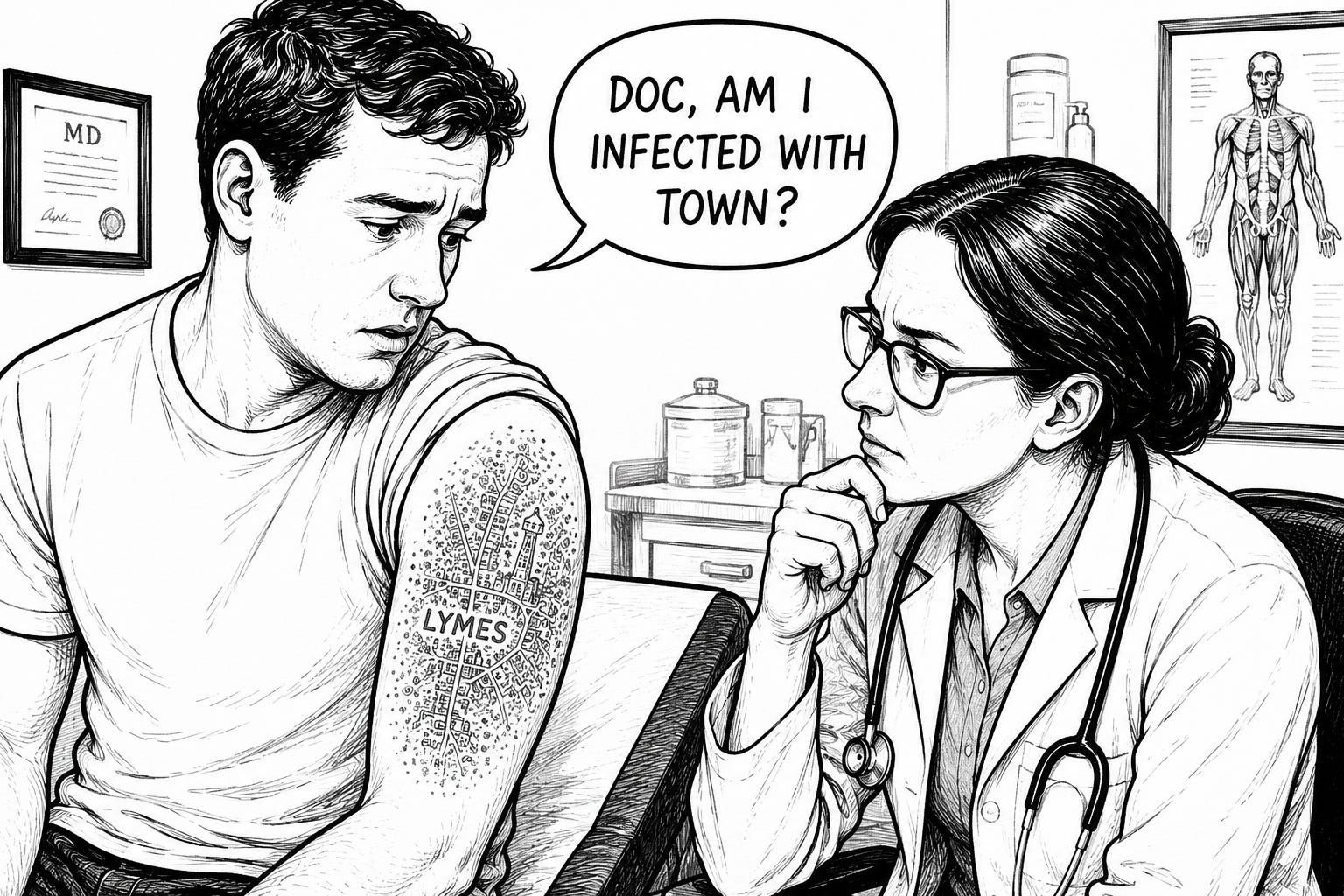
Geographic names. Lyme disease, Ebola, Marburg, Zika, West Nile. Linguistically, the patient is infected with a place. Nothing about the pathogen, the mechanism of injury, or the route of exposure survives into the name.
Descriptive names. Diabetes mellitus (sweet urine), lupus (wolf-like rash), influenza (influence of the stars). At least an attempt at description, but of the downstream symptom rather than the upstream cause. Sweet urine does not explain why pancreatic beta cells failed.
In every category, the name encodes the presentation rather than the process, the endpoint rather than the origin. And because medicine organises its entire institutional apparatus around these names (research funding categories, pharmaceutical pipeline targets, clinical specialty boundaries, patient advocacy structures), the name does not merely describe. It determines what questions are asked.
Lyme: The Assumption Cascade
Lyme disease is the cleanest demonstration of the naming problem because every component of the failure is visible, from the laboratory down to the consulting room.
In 1975, a cluster of juvenile arthritis cases appeared in Lyme, Connecticut. In 1981, Willy Burgdorfer identified the causative organism: a spirochetal bacterium, now called Borrelia burgdorferi. An organism was identified. A mechanism was documented. And then the condition was named after a town.
Consider what happens next, not in the laboratory but in a GP surgery, a walk-in clinic, or a hospital admission. A patient presents feeling unwell. They mention a tick bite. A clinician reaches for the label.
Here is where isolation should win. It almost never does.
A tick bite and feeling unwell do not constitute a diagnosis of spirochetal infection. A tick bite is one event. Feeling unwell is a state with dozens of possible explanations. Between those two data points lies a diagnostic gap that the name “Lyme disease” fills without evidence. You might have consumed contaminated food on the same day. You might have a compromised gut lining, what practitioners call leaky gut, through which bacteria from routine dietary exposure have entered the bloodstream. You might have eaten organic lettuce carrying Escherichia coli, an organism that undergoes binary fission every forty minutes and, once it crosses the gut barrier into the blood, causes direct red blood cell damage. Oxygen-carrying capacity drops. Energy plummets. You feel terrible.
Meanwhile, all clinical attention is on the tick bite. Assumptions are made. A label is assigned. And in many cases, that label is held as an identity for a lifetime, while nobody bothered to look.
Looking means putting blood under a microscope. Not running a culture. Not waiting for serology panels. Direct observation. A spirochete in human blood is a visible, identifiable organism. So is Staphylococcus. So is Streptococcus. So is E. coli. Direct microscopy identifies what is present in the blood in front of you, in real time, without the diagnostic lag of culture-based methods and without the interpretive ambiguity of serology that measures immune response rather than confirming the presence of the organism itself.
And once the organism is identified by direct observation, the treatment follows the identification. Anti-parasitical intervention, a ferricyanide salt for instance, can eliminate observable organisms faster than any antibiotic course, with confirmation of clearance under the same microscope that identified the problem. Identification, treatment, and verification in a single clinical sequence, tied to what is observed rather than what is assumed.
This is not how the system operates. Under the naming convention, a tick bite plus malaise equals “Lyme disease,” and the label generates its own treatment protocol regardless of whether anyone confirmed the presence of the organism it supposedly describes.
What the Name Creates
“Lyme disease” creates a bounded diagnostic category that feels specific when the underlying reality is a spectrum. Some patients develop a localised skin reaction that resolves. Some develop multi-system inflammatory damage that persists for years. Calling both by the same name collapses this spectrum into a single entity with a single treatment protocol and a single expected outcome, which then creates a clinical absurdity:
A patient has a confirmed Borrelia burgdorferi infection. Anti-parasitical treatment eliminates the spirochete. But the infection caused tissue damage, neurological, articular, cardiac, that persists after the organism is gone. A clinician says: you no longer have Lyme disease. A patient says: then why am I still symptomatic?
Once the name is “cured,” the ongoing damage is orphaned. No diagnostic category. No billing code. No research stream. Residual tissue damage, the clinical problem that matters most to the patient, falls into a gap between infectious disease (which considers its job done) and neurology or rheumatology (which were never involved because the condition was categorised as an infection, not an injury).
What a Clinical Conversation Reveals
Here is what this looks like in practice, drawn from repeated clinical experience with live blood microscopy.
A patient presents. “I have Lyme disease. I’ve had it for ten years.”
You place a drop of their blood under a microscope. You show them what a spirochete looks like in human blood: the characteristic corkscrew morphology, the motility pattern. Then you show them their own blood.
“Do you see any of these in your blood?”
“No. There are none of those in my blood, are there?”
“Correct. There are no spirochetes in your blood.”
“But I’ve got Lyme disease. I’ve had it for ten years.”
“When you were bitten by the tick, did anyone identify spirochetes in your blood? Or is this the first time you have heard the word spirochete?”
“Never heard of them. My doctor said if I’d been bitten by a tick and I didn’t feel well, it might be Lyme disease.”
“You do not have Lyme disease. Lyme is the name of a town. You cannot be infected with a postcode, and a postcode cannot be treated.”
“Then why do I feel terrible?”
“What does your diet consist of?”
And there, in the silence that follows, the investigation begins for the first time. Ten years after a label was assigned and never questioned.
What a Mechanistic Diagnosis Looks Like
Strip the geographic label and the diagnostic sequence becomes clear:
Identify what is present. Direct microscopy of blood, looking for spirochetes, bacteria, parasites, or other observable organisms.
Confirm or exclude infection. If spirochetes are present, infection is confirmed. If absent, the label is wrong and the investigation must broaden.
Map the tissue damage. Neurological, articular, cardiac, dermatological. Which tissues are injured, to what extent, and what is the current functional status.
Treat the organism and the injury as separate problems. Anti-parasitical intervention for the pathogen. System-by-system assessment and rehabilitation for the tissue damage.
Investigate alternative causation. Dietary exposure, gut barrier integrity, bacterial translocation, parasitic load from sources unrelated to tick bite. Confirm through observation, not assumption.
Under this framework, “Lyme disease” dissolves. It becomes: spirochetal infection (Borrelia burgdorferi), confirmed or excluded by direct microscopy, with secondary tissue injury assessed and addressed system by system, and alternative upstream causes investigated where spirochetal infection is absent. Every word in that description points toward a specific clinical action. “Lyme disease” points toward a town in Connecticut.
Pellagra: When the Name Dissolved, the Condition Disappeared
Pellagra was classified as a disease for decades. It had clinical criteria (the four Ds: dermatitis, diarrhoea, dementia, death). It had an institutional apparatus. It had competing theories of causation: infection, toxin exposure, genetic susceptibility. It had patients who were told they “had pellagra” as though pellagra existed independently of the conditions that produced it.
In 1914, Joseph Goldberger began demonstrating that pellagra was caused by niacin deficiency. His work was resisted for over a decade because the disease model was entrenched. Research communities had formed. Diagnostic criteria were established. Dissolving the category threatened all of it.
Goldberger was right. Pellagra was not a disease. It was an injury from inadequate niacin intake. Once the deficiency was identified and corrected, the condition ceased to exist. Not because a drug was developed. Not because a treatment protocol was optimised. The condition ceased to exist because a mechanistic understanding replaced a name, and made prevention trivial.
Before Goldberger: pellagra is a complex, mysterious disease requiring institutional investigation.
After Goldberger: niacin deficiency produces predictable tissue damage, correctable by dietary repletion.
Nothing about the condition changed. What dissolved was the framing. And the framing change is what made it preventable.
Scurvy: Evidence Ignored for Decades Because the Name Held
James Lind published his controlled trial on citrus fruit and scurvy in 1753. Sailors had been dying from the condition for hundreds of years before that, and continued dying for decades after Lind’s publication, because naval medicine could not reorganise around a dietary explanation for a condition it had classified as a disease.
Scurvy was ascorbic acid deficiency. Gum deterioration, skin lesions, old wounds reopening, haemorrhage. Every symptom was traceable to collagen synthesis failure caused by the absence of a single micronutrient. Every symptom was reversible by correcting the deficit, provided the damage had not progressed beyond recovery.
Lind’s evidence was available. Institutional action did not follow. The delay cost tens of thousands of lives. Not because of insufficient evidence, but because a name had created the expectation of a disease-model investigation: identify the entity, characterise it, develop treatments. As soon as scurvy was recognised as a dietary injury, the investigation was over and the prevention was obvious.
What Naming Obscures
Occam’s razor applied to the diagnostic landscape asks a question that the current naming convention cannot tolerate: how many conditions currently classified as discrete diseases are distinguishable injury patterns from a smaller number of upstream causes, given different names because they were observed in different tissues, at different stages, by different specialists?
Beriberi was thiamine deficiency. Scurvy was ascorbic acid deficiency. Pellagra was niacin deficiency. Rickets was vitamin D deficiency. Four “diseases,” each with its own diagnostic criteria, research community, and clinical infrastructure. One upstream category: micronutrient injury from inadequate dietary intake. Four names obscured the simplicity of the cause by insisting on the complexity of the presentation.
“Dropsy” was a symptom diagnosis, fluid retention, that collapsed heart failure, kidney failure, and liver disease into a single category. Dissolving the name into mechanistic components was what allowed specific treatment of each underlying cause. In that case, the name was an active barrier to correct diagnosis.
Modern Diagnostic Vocabulary: Endpoints Without Origins
A patient diagnosed with “Type 2 diabetes” is told they have a disease characterised by insulin resistance and elevated blood glucose. A metabolic endpoint is described. An upstream process is not. What caused the insulin resistance? Chronic hyperinsulinaemia from decades of refined carbohydrate consumption? Mitochondrial dysfunction from lipid peroxidation? Adipose tissue inflammation from chronic caloric excess? Each upstream cause has a different optimal intervention. A single label treats them as one condition with one protocol.
A patient diagnosed with “essential hypertension” is told they have high blood pressure with no identifiable cause. In medical terminology, “essential” means the cause is unknown. A measurement combined with an admission of ignorance. Lifelong antihypertensive medication manages the measurement while the name provides justification for never investigating further.
A patient diagnosed with “irritable bowel syndrome” is told they have a syndrome, a cluster of symptoms, affecting their bowel. Words that describe what the patient already knew before they walked into the consulting room, with “syndrome” appended to create the appearance of a defined clinical entity. Food sensitivities, dysbiosis, bile acid malabsorption, visceral hypersensitivity, mast cell activation, small intestinal bacterial overgrowth. Each mechanistically distinct, each requiring different investigation and intervention. A single label wrapping them all discourages differential investigation.
Three Categories the Word “Disease” Obscures
If the naming convention were rebuilt from first principles, conditions currently labelled as “diseases” would fall into three categories:
Injury from identifiable exposure. Nutritional, chemical, environmental, or radiation injury where tissue damage is the downstream consequence of exposure to a specific agent or deficiency of a specific substance. Identify the exposure, cease it, assess the damage, and support recovery system by system. Many conditions labelled as chronic diseases belong here.
Infection by a specific organism. Bacterial, viral, fungal, or parasitic infection where the pathogen is identifiable, ideally by direct observation under microscopy, and tissue damage is the consequence of the organism’s activity and the immune response to it. Identify and eliminate the organism through targeted anti-parasitical intervention, then assess and treat residual tissue damage as a separate clinical problem. Confirm clearance by the same method that confirmed presence.
Genetic structural variation. Conditions arising from inherited or de novo genetic mutations that alter cellular structure or function. Identify the specific genetic variant, understand the mechanistic consequence, and manage downstream effects with reference to the biology rather than to a discoverer’s surname.
“Disease” collapses all three into a single conceptual category implying that you have caught or developed a discrete entity, which must be fought, managed, or endured. That framing serves pharmaceutical intervention models. It serves patients and prevention poorly.
What the Name Costs
Research funding flows to the wrong targets. Clinical protocols manage symptoms instead of investigating causes. Patients are told their condition is incurable when what has failed is the institutional commitment to a label that was never a diagnosis. Prevention strategies are never developed because the naming convention defines a condition as something to be treated rather than something to be traced upstream and eliminated.
Pellagra killed people until the name was dissolved. Scurvy killed people for decades after the cause was identified. In both cases, the delay between evidence and action was mediated by a naming convention that substituted a label for an investigation.
How many conditions labelled as diseases today are waiting for their Goldberger? How many patients are carrying a town’s name as a diagnosis while nobody has put their blood under a microscope?
When a clinician delivers a diagnosis, two questions determine whether you have received information or been filed:
What is the mechanism causing this?
And does the name tell me anything about it?
If the answer to the second question is no, the name is not a diagnosis. It is a filing system. And filing systems are administrative conveniences, not explanations.
“Doc, am I infected with a town?”
“No. But before I tell you what you have, I need to look at what is in your blood. Not guess. Not assume. Not infer from a tick bite. Look.”
“And if there are no spirochetes?”
“Then we widen the investigation. What have you eaten? What is the state of your gut lining? What organisms are present that should not be? Direct observation first. Diagnosis second. Name last, if at all.”
“My last doctor gave me the name first.”
“And in ten years, did anyone look?”
“No.”
“Then you have never been diagnosed. You have been labelled. And the label stopped everyone, including you, from asking the question that matters: what is mechanistically wrong, and what does your blood show?”
WattyAlan Reports. Town’s Disease Series, Part One. Adam White.
eat sleep repeat, the convenient slippery slope to which resistance is near to futile for the inquisitive medical practitioner. Labels, dogma and rhetoric forced down the gullet of the new young minds trying to find their way through to a 'successful' career. Oh the waste!!