

El Milagro de la Paz - The Peace Miracle
So it is described domestically. What follows examines how that outcome was produced, and at what cost.
This report examines El Salvador’s transformation under Nayib Bukele through the Sovereignty-Results Framework, evaluating security restoration, state capacity expansion, economic reactivation, and the institutional costs incurred.
Volcanoes shaped this land. Izalco, the "lighthouse of the Pacific," erupted continuously for two centuries before falling silent in 1966. Like the geological forces that forged El Salvador's dramatic landscape, transformation here arrives not gradually but in explosive, world-altering bursts. The same pattern would repeat six decades later, though this time the eruption would be political.
In 2015, death stalked these volcanic slopes with unprecedented fury. El Salvador recorded 105 homicides per 100,000 citizens, a rate that transformed daily existence into a survival calculation. Mothers counted heartbeats until children returned from school. Bus drivers paid tribute to gang commanders like medieval serfs serving feudal lords. Entire neighborhoods vanished behind invisible borders patrolled by teenagers wielding automatic weapons.
Today, that same landscape hosts families picnicking in parks that stood abandoned for decades. The homicide rate has plummeted to 1.9 per 100,000, lower than Canada, safer than most of Europe. This transformation defies every expert prediction and challenges fundamental assumptions about governance, democracy, and the price of peace.
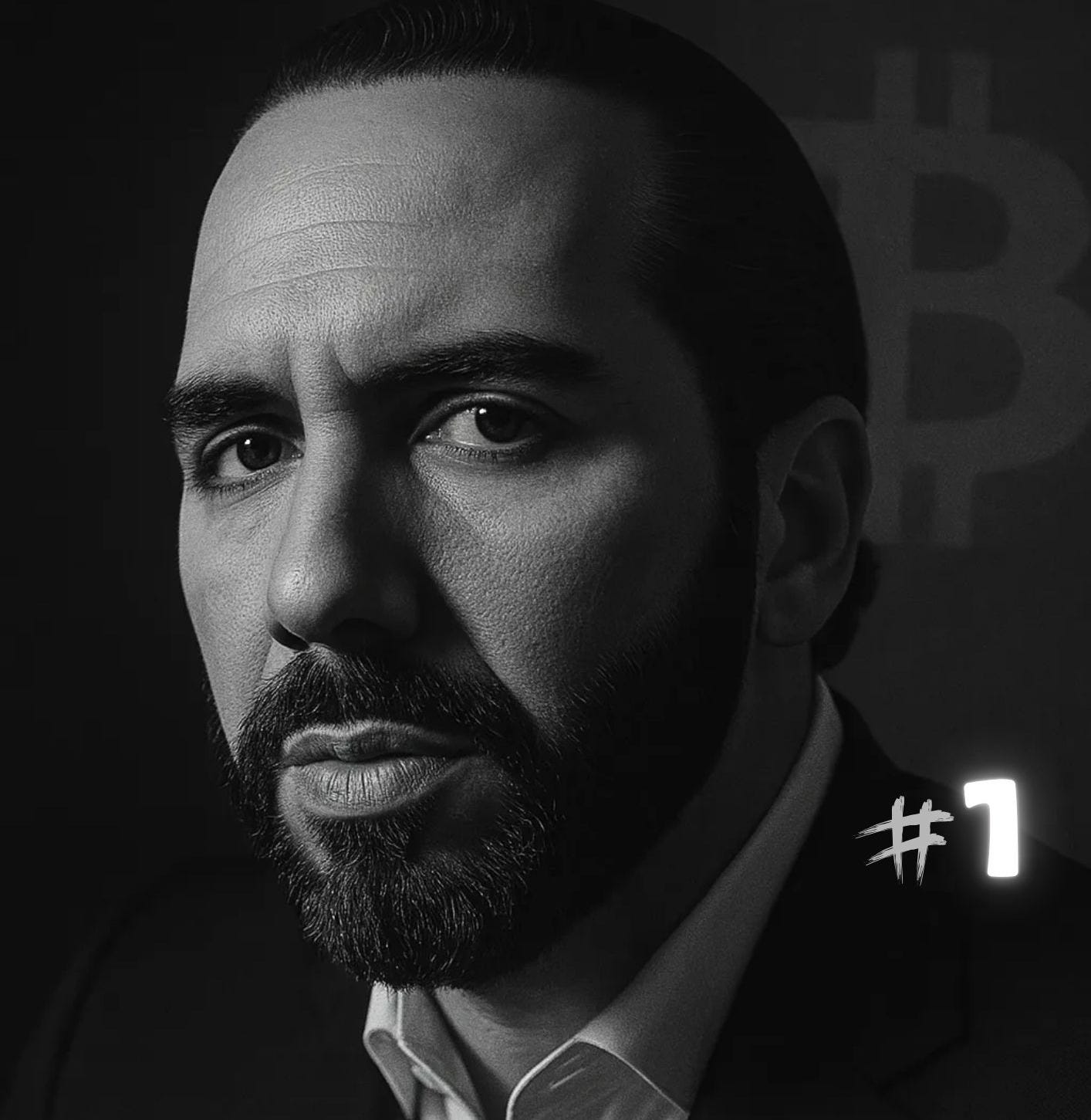
At the center stands Nayib Bukele, a 43-year-old millennial who governs by Twitter, calls himself "the world's coolest dictator," and maintains approval ratings that would make any politician weep with envy. His story reveals how genuine transformation emerges from the collision between desperate circumstances and audacious leadership, and why traditional political frameworks may be inadequate for understanding 21st-century governance.
Independent thinking for independent minds.
The Making of a Revolutionary
Understanding Bukele requires understanding El Salvador's unique crucible. Born in 1981 to a Palestinian father and Catholic mother, he came of age during the final tremors of a civil war that claimed 75,000 lives. While his contemporaries in stable democracies debated university majors, young Salvadorans navigated a landscape where political violence was generational trauma and gang warfare was emerging inheritance.
Bukele's youth was marked by this duality, privilege enough for education and opportunity, proximity enough to violence and chaos to understand their costs. His father, Armando Bukele Kattán, built a successful business empire while maintaining connections across El Salvador's fractured political spectrum. The family's Palestinian heritage placed them slightly outside traditional power structures, perhaps fostering the outsider perspective that would later define his political approach.
Unlike traditional politicians who climbed party hierarchies for decades, Bukele built his early career in advertising and business. This background proves crucial to understanding his governance style, he thinks in campaigns, measures success through approval ratings, and communicates directly with consumers rather than through institutional intermediaries.
His political ascent began in local government, serving as mayor of Nuevo Cuscatlán and later San Salvador. These positions offered laboratories for testing unconventional approaches. He revitalized downtown areas through infrastructure investment, used social media for direct citizen engagement, and demonstrated that dramatic improvements were possible when leaders prioritized results over process.
The traditional political establishment initially dismissed him as a social media personality lacking serious credentials. This miscalculation would prove catastrophic for established parties. Bukele's youth became an asset rather than liability, he spoke the language of a generation raised on digital communication and frustrated with institutional failure.
When he announced his presidential candidacy in 2018, major parties had already selected their nominees through traditional processes. Bukele founded Nuevas Ideas (New Ideas) and ran on a simple platform: everything must change because everything had failed. The message resonated with a population exhausted by decades of false promises and escalating violence.
Inheritance of Terror
The country Bukele inherited in June 2019 represented a case study in state failure. MS-13 and Barrio 18 weren't merely criminal organizations, they had evolved into parallel governments controlling 247 of El Salvador's 262 municipalities. These gangs operated sophisticated taxation systems, collected monthly tribute from businesses, and maintained territorial control more extensive than many rebel groups during the civil war.
The economics of terror were staggering. A single MS-13 cell generated over $100,000 monthly from one market district alone. Bus companies surrendered $6,000 per month for route access. Street vendors handed over daily earnings to avoid execution. The gangs had transformed extortion from crime into a shadow taxation system affecting 6.5 million people.
Previous governments tried everything: negotiation, rehabilitation programs, foreign aid initiatives, military deployments. President Mauricio Funes secretly negotiated with gang leaders, achieving temporary reductions in violence at the cost of legitimizing criminal organizations. President Salvador Sánchez Cerén deployed military forces, triggering escalation that pushed homicide rates to historic peaks.
By 2019, the failure was complete. Nearly 400,000 Salvadorans—roughly 6% of the entire population, had fled to the United States. Those remaining lived under conditions resembling military occupation, except their occupiers were teenagers collecting tribute rather than soldiers maintaining order.
Into this chaos stepped a former advertising executive with no military experience, no traditional political backing, and no clear ideology beyond pragmatic problem-solving. What he possessed was something more valuable: a willingness to break every conventional rule.
A Security Revolution
Bukele's approach began with strategic deception. For two years after taking office, he quietly negotiated with gang leaders while publicly maintaining tough rhetoric. Homicides dropped 66% during this period even as arrests decreased 25%. The approach was working, until it catastrophically wasn't.
March 2022 marked the turning point. Gangs orchestrated a killing spree that left 87 people dead across a single weekend. The message was unmistakable: they still controlled the country's destiny. Bukele's response would redefine the possible.
Within hours, he declared a state of emergency suspending constitutional rights including habeas corpus, freedom of movement, and legal defense guarantees. Then came the unprecedented escalation: mass arrests targeting not just active gang members but their entire support networks.
The scale defies comprehension. Security forces have arrested over 85,000 people since March 2022, approximately 1% of the entire population. They identified 52,541 MS-13 members, 13,682 Barrio 18 Sureños, and 10,741 Barrio 18 Revolucionarios. More critically, they captured 1,232 gang leaders across all organizations.
To house this massive population, Bukele constructed the world's largest prison: Centro de Confinamiento del Terrorismo (CECOT). This $100 million facility can hold 40,000 inmates under conditions designed to prevent any possibility of continued criminal operations. Prisoners spend 23.5 hours daily in cells, receive no visitors, and have no access to rehabilitation programs.
The mathematics of transformation are irrefutable. Daily homicides dropped from 18 in 2015 to 0.31 in 2024. Extortion complaints fell 54%. Gang territorial control collapsed across virtually every urban area. Parents report children playing in parks abandoned for decades. Women describe walking alone at night for the first time in their adult lives. These outcomes are inseparable from the suspension of procedural safeguards and the concentration of executive power.
Critics document valid concerns: 350+ deaths in custody, systematic torture reports, arbitrary arrests, overcrowded prisons. These violations are serious and troubling. But they must be weighed against an uncomfortable truth: the policy works. El Salvador's 91% approval rating for Bukele reflects genuine gratitude from a population held hostage by criminal organizations for decades.
La Transformación Económica - Economic Renaissance
Security improvements enabled broader economic revival. With gangs neutralized, investment became possible for the first time in decades. Tourism exploded from traditional levels to 3.4 million visitors in 2023, generating $3.8 billion in foreign exchange. The sector now contributes 11% of GDP, double Costa Rica's percentage despite El Salvador's historically violent reputation.
Foreign direct investment responded accordingly. After years of negative flows, FDI reached $759 million in 2023, a 344% increase representing the highest level during Bukele's presidency. Google opened its first Central American technology hub in El Salvador. JW Marriott announced its first luxury hotel project. International companies began rediscovering a market they had written off as uninvestable.
Infrastructure development followed security success. The Chinese-funded National Library, a $54 million architectural marvel rising in San Salvador's historic center, symbolizes transformation of districts deemed too dangerous for investment just five years earlier. Port of La Unión received $400 million in modernization investments. The government committed $1.4 billion to eastern region development, including the Gerardo Barrios Beltway and Los Chorros Viaduct.
These projects transcend mere construction, they represent a nation reclaiming its future through concrete and steel. Highway expansion reflects implicit belief in a future where citizens can traverse their homeland freely. Port modernization signals renewed confidence in long-term economic trajectory. The National Library stands as a monument to intellectual possibility in a country that had prioritized mere survival.
The Digital Presidency
Bukele's governing style revolutionizes democratic engagement through technological innovation. He operates as the first president to systematically use social media as a governing instrument, issuing executive orders through Twitter and maintaining direct communication with 2.6 million followers. His 75,000+ tweets since 2009 represent a new form of democratic participation, or democratic bypassing, depending on perspective.
This approach transcends mere communication strategy. Bukele governs through Twitter, publicly directing cabinet members, announcing policy changes, and engaging with international leaders. He has created unmediated relationships with citizens that bypass traditional media, opposition parties, and even formal government structures.
The style reflects deeper insights about 21st-century governance: institutions matter less than results, legitimacy flows from performance rather than process. Bukele maintains higher approval ratings than any contemporary leader precisely because he delivers measurable improvements to citizens' daily lives while communicating those successes directly.
His communication deliberately embraces casual aesthetics, leather jackets, backwards baseball caps, millennial slang. The "world's coolest dictator" self-designation uses humor to deflect criticism while accomplishing serious authoritarian objectives. This represents masterful political branding that other leaders across Latin America desperately attempt to replicate.
A Bitcoin Gamble
Perhaps no policy better illustrates Bukele's unconventional approach than making Bitcoin legal tender. In September 2021, El Salvador became the first country adopting cryptocurrency as official currency alongside the U.S. dollar, a decision widely criticized as economically reckless and technically unworkable.
International institutions predicted disaster. The IMF urged reversal. World Bank refused assistance. Traditional economists forecast economic collapse. Early adoption proved limited, only 12% of Salvadorans currently use Bitcoin for transactions.
Bukele wasn't optimizing for immediate adoption. He was positioning El Salvador as a financial sovereignty pioneer challenging traditional monetary systems. The government accumulated 6,194 Bitcoin through daily purchases and geothermal mining operations. At current values, these holdings are worth approximately $646 million, showing 117% returns year-to-date.
More importantly, the Bitcoin experiment established El Salvador as cryptocurrency tourism destination and innovation hub. "Bitcoin Beach" attracts international visitors. The country hosts major cryptocurrency conferences. Technology companies establish Central American operations in San Salvador.
Long-term economic impact remains unclear, but symbolic impact is undeniable: El Salvador positioned itself as financial pioneer rather than aid recipient. That narrative shift and transformed self-perception may prove more valuable than immediate economic returns.
Regional Influence and the Bukele Model
Bukele's success reverberates across Latin America with profound implications for democratic governance. His approval ratings exceed those of domestic politicians in Colombia, Ecuador, and Chile. The "Bukele model" undergoes study and partial implementation in Honduras, Guatemala, and Argentina. Ecuador's Daniel Noboa directly emulates mass prison construction and state of emergency approaches. Its replicability remains uncertain outside El Salvador’s specific conditions of total security collapse.
This influence reflects broader frustration with traditional democratic institutions throughout the region. Citizens observe El Salvador's transformation and question why their governments cannot deliver similar results. They see Bukele's 91% approval rating and compare it to their own leaders' single-digit numbers.
International recognition followed domestic success. Time Magazine named Bukele among the world's 100 most influential people. He consistently ranks as the globe's most popular leader in international surveys. The transformation story captured global attention precisely because it seemed impossible.
The comparison proves both inspiring and troubling. Bukele demonstrates that dramatic improvement is possible when leaders prioritize results over process. However, he also shows how democratic institutions can be systematically dismantled while maintaining popular support—a template other ambitious politicians eagerly study for replication.
The Sovereignty-Results Validation
Measured against the five parameters that distinguish genuine achievement from political theater, Bukele's performance validates the sovereignty-results framework with mathematical precision:
Domestic Legitimacy: His 91% approval rating and 84.65% electoral victory in 2024 represent authentic popular support verified by credible polling organizations. This legitimacy flows from delivered results rather than international establishment approval.
Economic Delivery: Tourism revenue increased to $3.8 billion generating 11% of GDP. Foreign direct investment reached $759 million in 2023—a 344% increase. Infrastructure development accelerated with $1.4 billion committed to eastern region projects. These represent measurable improvements relative to starting conditions.
Sovereignty Index: The Bitcoin adoption, Chinese infrastructure partnerships, and independence from traditional international organizations demonstrate policy autonomy despite external pressure. Bukele consistently prioritizes national interests over conditional aid requirements.
Crisis Resilience: Navigation of the 2022 gang violence escalation, international criticism of emergency measures, and economic pressures from global institutions prove institutional adaptation capabilities while maintaining development momentum.
Tangible Progress: Citizens experience concrete improvements in daily life, freedom of movement, economic opportunity creation, infrastructure access, and basic security. These represent measurable outcomes rather than promises or rhetoric.
The context multiplier amplifies these achievements: Bukele inherited a failed state facing existential crisis, operated under intense international pressure, and accomplished transformation in just five years with limited resources.
The Future of Transformation
Bukele's story continues evolving, but broader implications crystallize clearly. He demonstrates that dramatic transformation remains possible when leaders prioritize results over process. He proves how modern communication technology enables direct democratic engagement. He shows that small countries can achieve global influence through bold policy experiments.
The model he created, combining authoritarian methods with democratic legitimacy, spreads across Latin America and beyond. Other leaders study his approach, adapt his methods, and attempt replicating his success. The "Bukele model" becomes a template for ambitious politicians seeking rapid transformation while maintaining popular support.
Whether this model proves sustainable awaits future determination. Bukele's success depends on continuing to deliver results while managing tensions between effectiveness and democracy. The institutional changes he implemented may prove difficult to reverse, creating long-term risks for democratic governance.
For now, the transformation remains real and remarkable. A country surrendered to criminal organizations became the hemisphere's safest. A population living in fear can move freely through their own streets. A leader governing by Twitter achieved the world's highest approval ratings.
The Bukele miracle demonstrates that transformation is possible when leaders possess courage to break conventional rules and competence to deliver results. It challenges comfortable assumptions about democracy, governance, and development, suggesting that politics' future may look dramatically different from its past.
In a world where traditional institutions struggle addressing contemporary challenges, Bukele offers an alternative model: prioritize results over process, communicate directly with citizens, measure success through citizen satisfaction rather than institutional approval. This model works, at least short-term, making it both inspiring and dangerous.
The world watches El Salvador not just for what Bukele accomplished, but for what his success suggests about governance itself. This millennial president oversaw one of the fastest security reversals in modern state history, his success may reshape how we understand leadership, democracy, and the price of peace.
"La paz no tiene precio, pero sí tiene un costo" -
Peace has no price, but it does have a cost.
Bukele paid that cost, and his people overwhelmingly believe the exchange was worth it.
Knowledge is power but wisdom is king.
Share wisdom, its good.