

The Institutions Only Hear From Themselves
READ WITH ''YOU CANT EAT SANCTIONS''
Two years. Forty-five hundred approaches. One substantive reply. A channel that exists at every tier and functions at none.
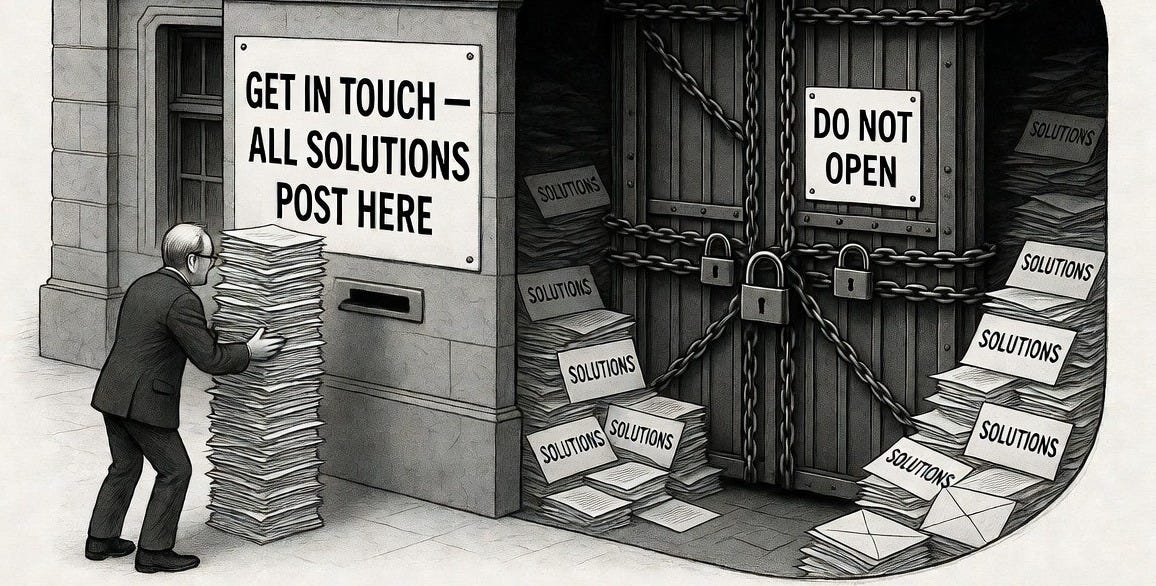
This report documents a finding that was not the object of the investigation. The observer was engaged in sustained primary work across three domains: energy security, agricultural supply chain analysis, and structural commercial research.
Each project produced material intended to reach the institutions whose decisions the material bore on, and each was distributed through the channels those institutions themselves publish for exactly that purpose.
Across two years and forty-five hundred approaches, the institutions returned one substantive reply.
A side observation. It refused to go away.
The Dataset
Two years of approaches, divided across three professional domains and every tier of the institutional architecture available to an outside researcher operating under a real name with published credentials.
Commercial tier. Small business contact forms, regional hospitality operators, national retail chains, SME enterprise inbound. Over a hundred direct approaches across multiple business categories in the final sixty days of the period alone.
Industrial tier. Major fertiliser producers including a dominant phosphate processor. Agricultural supply chain operators. Food security infrastructure.
Governmental tier. UK departmental contacts. American state and federal agencies. American port authorities on both seaboards. European parliamentary offices across thirteen member states. A European presidential office.
Financial tier. Development banks. Multilateral lending institutions. National banking contacts.
Academic tier. University faculty. Research institutes. Named academics publishing in adjacent fields.
Journalistic tier. Substack correspondents. Broadcast investigative figures. Editorial desks.
Personal tier. Direct personal websites of individuals publishing in the same subject domains.
Aggregate response rate across the full spectrum sits below one in a thousand. One substantive reply, from the lowest tier of the architecture, from a small business, in response to a reciprocity offer. Every other tier, across every content domain, across two years, returned nothing.
Three Doors
Three inbound channels carried the test, each designated by the institutions themselves as the proper route for unsolicited external communication.
First: direct email to a named recipient. Roughly forty-five hundred such approaches over the period. Subject matter varied. Sender architecture did not. Every message carried a real name, a verifiable domain, published work, and a specific solution-oriented proposition, and the reply rate sits below one in a thousand.
Second: the contact form. The channel the organisation built to receive exactly this kind of inbound, advertised on the public-facing website, presented as the route the organisation wants for cold communication from people it does not know. Over a hundred such submissions across the period. Four returned an automated acknowledgment stating a response would follow within a defined window. None produced that response. The remaining ninety-six returned nothing at all.
Third: the automated acknowledgment itself. Those four cases where it fired constitute a separate finding. Acknowledgment performs responsiveness without delivering any. A gesture substitutes for the action the gesture refers to. Rarer than full silence. Most organisations at most tiers do not bother to perform even the gesture.
Three doors. One of them has a bell that sometimes rings. None of them open.
Tier Independence
What lifts this above local observation is the tier independence. The pattern holds from the smallest commercial operator to the office of a head of state. Same architectural feature, the public inbound channel, at every tier of the institutional spectrum. Same failure mode, at every tier.
Scale-independence points to the institutional form itself.
The variable is architectural. As a shared feature of modern organisations, the public inbound channel has been structurally decoupled from the human decision layer across the entire spectrum.
Channel receives. Channel does not transmit. Form preserved. Function gone.
Absorption Without Correspondence
Primary work continued throughout the two-year period. It was published.
It reached readers. A second pattern sits alongside the inbound-channel failure and clarifies it.
A researcher operating in cognitive liberty and neurotechnology received material through published distribution channels, used it, cited it in a book published afterwards, and did not correspond.
An investigative broadcaster working in agricultural collapse requested material directly, received it, went silent. This is the signature behaviour of the new equilibrium.
Material is absorbed. Reply is not performed.
Reception and acknowledgment have been separated. Historically the two channels ran together. Work that reached someone produced, at minimum, a return signal, and that return signal told the writer the work had landed.
The signal has gone dark. The landing continues. The writer no longer knows.
What This Means
An outsider cannot reach an insider through the channels the insider’s organisation publishes for that purpose. The channels still exist.
They still receive. They no longer transmit. Information from outside the institutional perimeter does not enter institutional processing unless it arrives through pre-existing institutional relationship.
The institution now only hears from itself.
Consequences follow for anyone operating outside institutional cover. Researchers, writers, independent analysts, commercial operators seeking enterprise contact, citizens attempting to reach their own government, all now face the same closed apparatus.
That apparatus advertises openness and performs it through the visible presence of contact forms, published email addresses, parliamentary correspondence procedures, investor relations desks, media enquiry lines. Openness is theatrical.
Closure is structural.
Consequences follow for the institutions too.
An institution unable to receive external input operates with its own output as its only data source.
The feedback mechanism that historically connected institutional decision-making to the environment the institution operates in has been disconnected. Institutions continue to act on the environment.
The environment can no longer act on institutions, at least not through the channels institutions publish.
Before and After
Two years is long enough to capture a transition. Earlier work, in the period preceding the current dataset, operated in an environment where at least some tiers of the institutional architecture returned substantive responses. Commercial inbound produced commercial replies. Academic inbound produced academic correspondence. Governmental inbound produced, at minimum, a departmental referral. Imperfect channels, but functional ones.
The shift is recent, and documentable by anyone operating across this same architecture before and after the change. This report declines to adjudicate the cause. Mass AI-generated inbound coincides with the shift, though the shift may equally reflect a structural transformation of institutional capacity that preceded the AI wave and merely accelerated with it. Causation requires separate treatment. The observational finding does not depend on it.
What remains is the pattern. Forty-five hundred approaches over two years, across every tier of the institutional architecture, across three distinct content domains, carrying documented solutions to problems the recipients themselves have stated publicly they are working on. One reply.
Closing Observation
This report stops here because its function is documentation. Primary work continues. Material continues to circulate through the distribution channels that still function. Readers continue to absorb it and in some cases act on it. Institutions continue to not reply.
What changes is the expectation. Anyone still writing letters into the apparatus should understand what they are writing into.
A wall with a slot.
A slot the institution installed to signal openness, connected on the far side to a bin.
The work still has value. The channel has none.
A writer who accepts this can continue working. A writer who does not accept it will eventually mistake the silence for a verdict on the work, and the work will stop.
That is the reason this report exists.