

WHAT THE EV. Part 5. Fire at Sea: How Battery Cargo is Rewriting Maritime Risk Jun 21, 2025
When the Ocean Burns
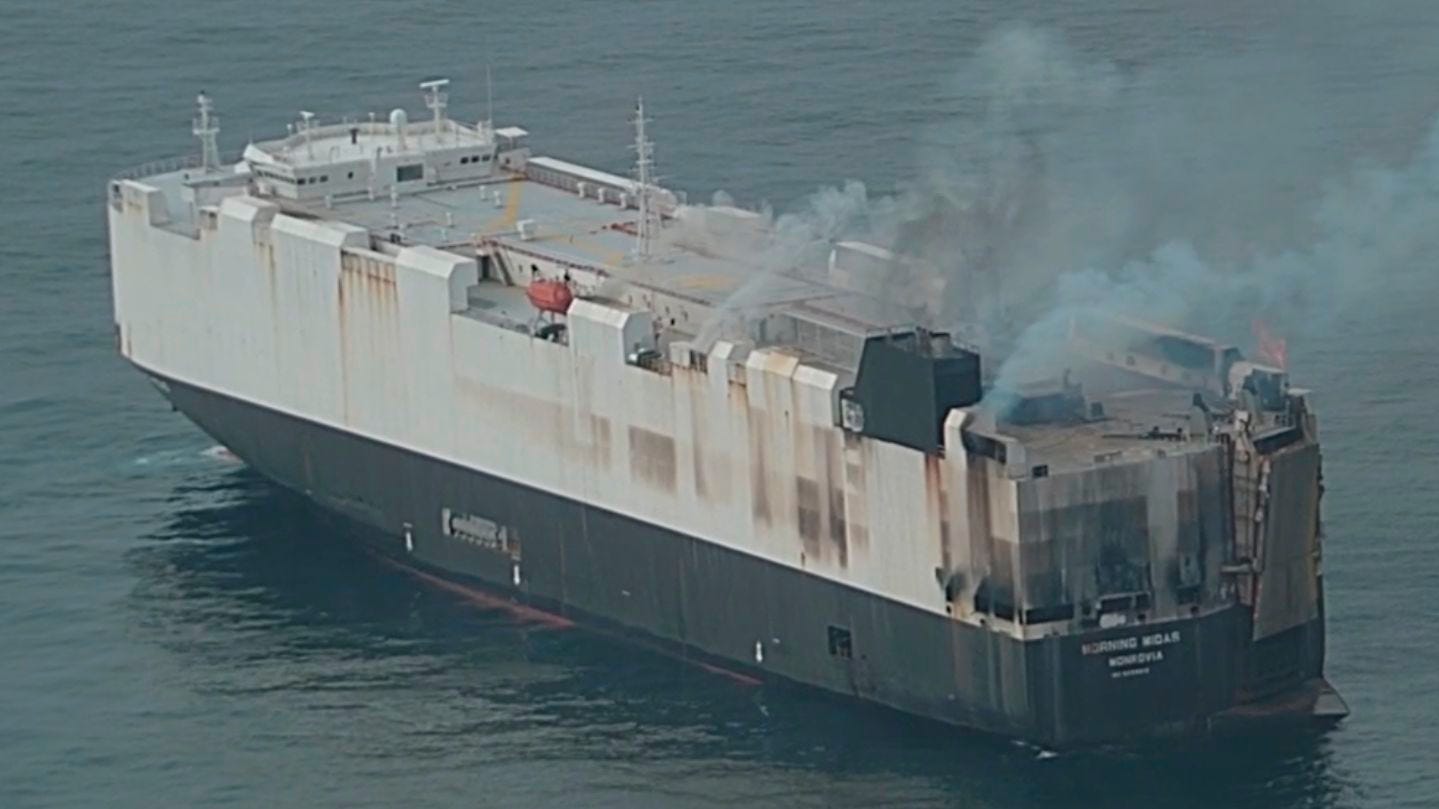
Three hundred miles south of Alaska, where no fire department can respond, the Morning Midas became a floating inferno. Smoke began pouring from cargo decks on June 3, 2025. The Liberia-flagged vessel carried approximately 3,000 vehicles, including 70 fully electric and 680 hybrid vehicles, bound for Mexico.
Within hours, all 22 crew members had abandoned ship. Hundreds of millions in cargo burned uncontrolled in the Pacific.
The fire lasted three weeks. When the ship finally sank on June 24, it took more than vehicles and cargo to the ocean floor. Gone too was any illusion that the electric vehicle revolution remained purely a land-based transformation. The ocean had become the latest theater in the EV transition's unintended consequences.
This investigation reveals how electric vehicles, marketed as environmental solutions, created new forms of maritime catastrophe. Battery chemistry that powers clean transportation becomes uncontrollable wildfire at sea. Supply chains optimized for cost efficiency ignored the physics of lithium-ion thermal runaway. The race to dominate EV exports transformed cargo ships into floating powder kegs.
A New Fire Season
Maritime fire incidents reached a decade high in 2024. Officials recorded 250 incidents, representing a 20% increase from the previous year. Container and cargo ships accounted for approximately 30% of these fires. What was once rare emergency has become routine maritime hazard.
This investigation traces power structures from Chinese factories to Congolese mines, from shipping fires to state surveillance systems. Subscribe for full access to research that mainstream coverage won't touch.
The pattern reveals itself through recent wreckage:
Morning Midas (June 2025): En route from China to Mexico with 70 fully electric and 680 hybrid vehicles among approximately 3,000 total vehicles, abandoned after fire in Pacific, hundreds of millions in losses
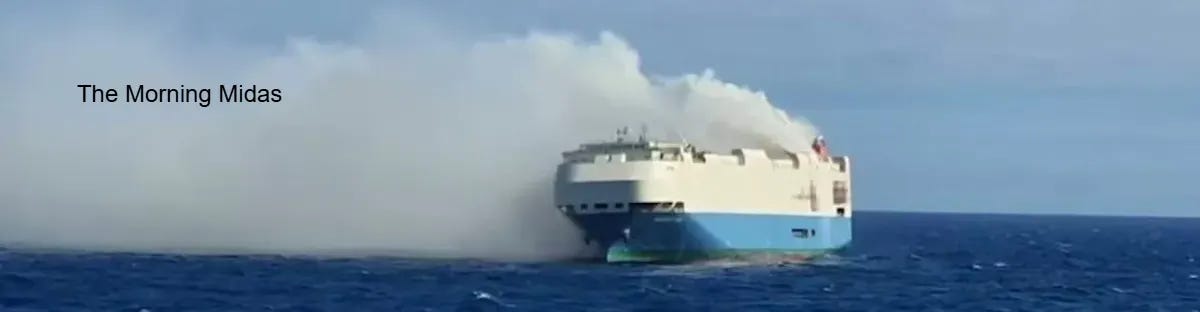
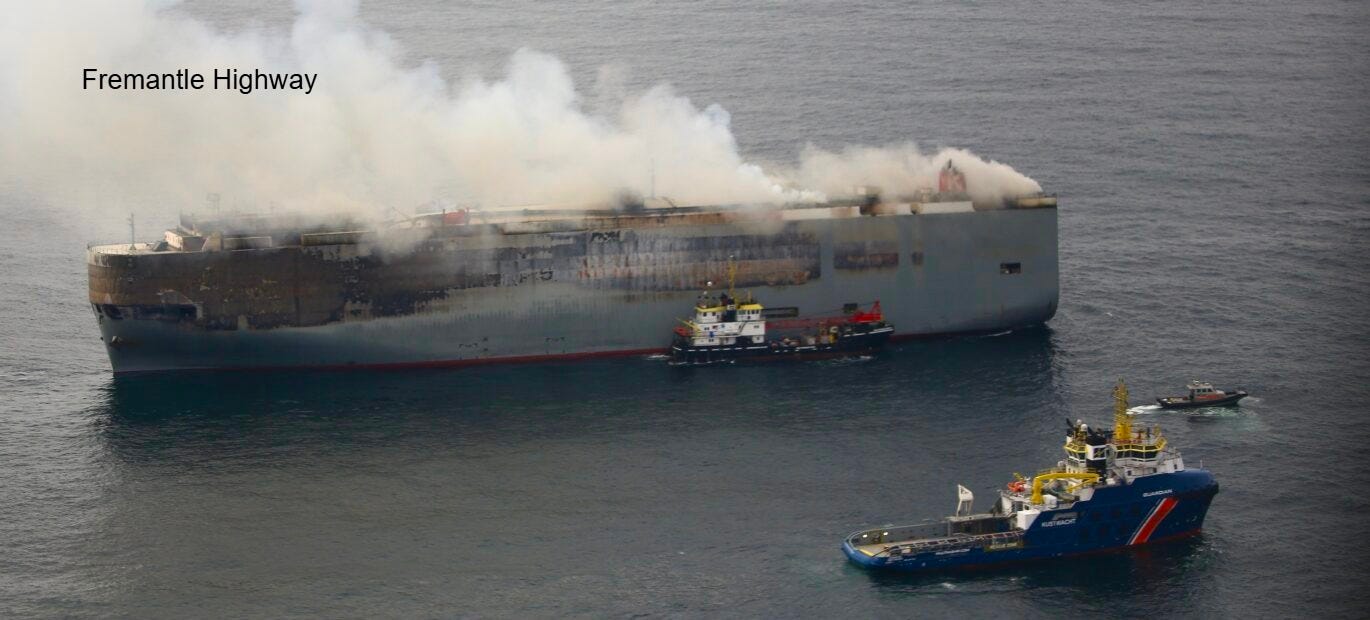
Fremantle Highway (July 2023): Carrying 498 EVs among 3,783 vehicles from Germany to Singapore, fire started "in the battery of an electric car," one crew member died
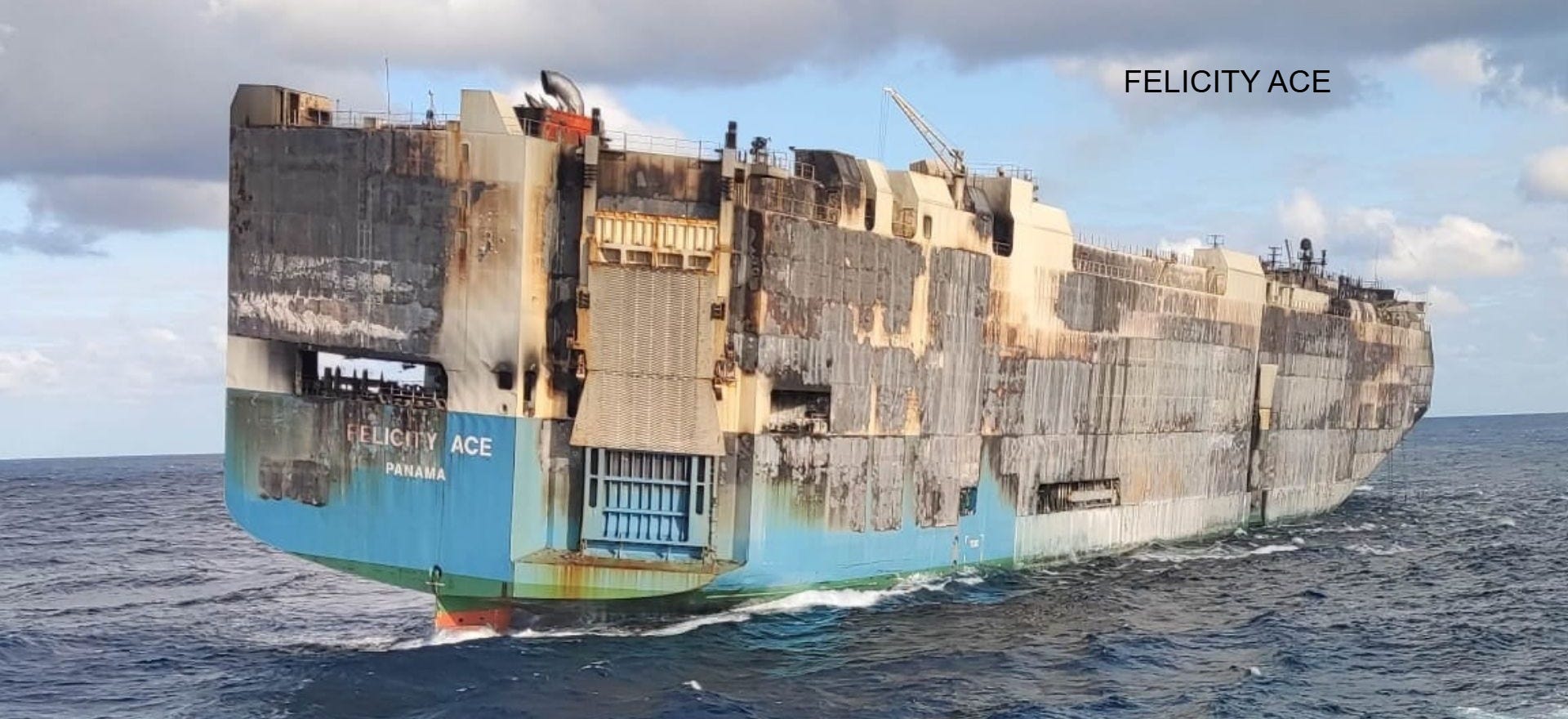
Felicity Ace (February 2022): 4,000 luxury vehicles including EVs, fire blamed on lithium-ion thermal runaway, sank after two weeks, $438 million in cargo losses
Höegh Xiamen (June 2020): 2,420 used vehicles, fire from disconnected EV battery, burned for over a week
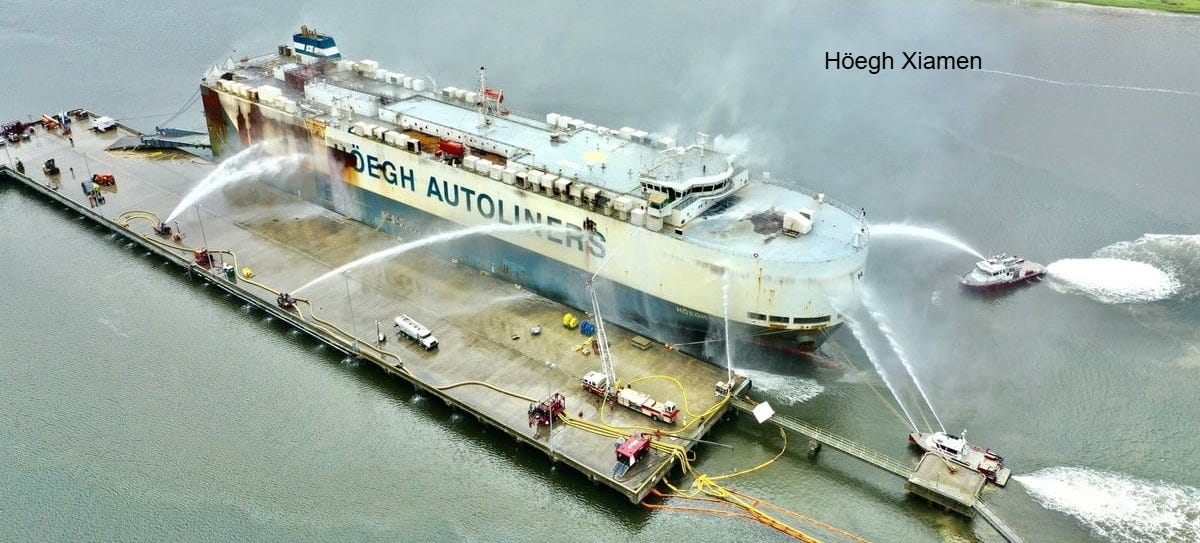
Each incident follows a similar trajectory. Lithium-ion batteries experience thermal runaway: an unstable chemical reaction producing enormous heat. Standard firefighting fails because water cannot penetrate battery casings. The fires reignite repeatedly. Crews evacuate. Ships burn for days or weeks. Eventually, vessels sink or reach port as charred hulks.
The shipping industry has transported dangerous cargo for centuries. Chemicals, fuels, explosives all presented known risks with established protocols. Electric vehicles represent something different: consumer products that become maritime weapons when they malfunction.
Physics of Uncontrol
Understanding EV shipping fire devastation requires examining lithium-ion battery failure properties. Traditional vehicle fires burn fuel and stop. Battery thermal runaway creates self-sustaining chemical reactions that resist conventional suppression methods.
When lithium-ion cells overheat, whether from collision damage, manufacturing defects, or electrical faults, they enter thermal runaway. Cell temperatures spike above 600°C (1,100°F). This releases flammable gases and superheated particles. These particles ignite neighboring cells, creating cascade effects throughout battery packs within minutes.
Water, the maritime firefighter's primary tool, actually worsens lithium fires. It reacts with lithium to produce hydrogen gas and lithium hydroxide. Both compounds are highly flammable. Foam systems fail because batteries burn from within sealed casings. Carbon dioxide systems work temporarily, but batteries reignite when oxygen returns.
Only one suppression method proves effective: sustained flooding with massive water volumes for thermal management rather than fire suppression. This approach remains impossible on cargo ships designed to stay afloat.
Ship designers optimized cargo holds for maximum vehicle density, not fire containment. Cars park inches apart across multiple decks connected by ventilation systems. When one vehicle ignites, flames and toxic gases spread rapidly through confined spaces where crew cannot safely operate firefighting equipment.
Modern car carriers like those in BYD's fleet can hold over 9,000 vehicles. These spaces span areas the size of football fields. A single battery failure can cascade through hundreds of adjacent vehicles in minutes. The resulting fires become too large and intense for any shipboard suppression system.
BYD's Logistics Gamble
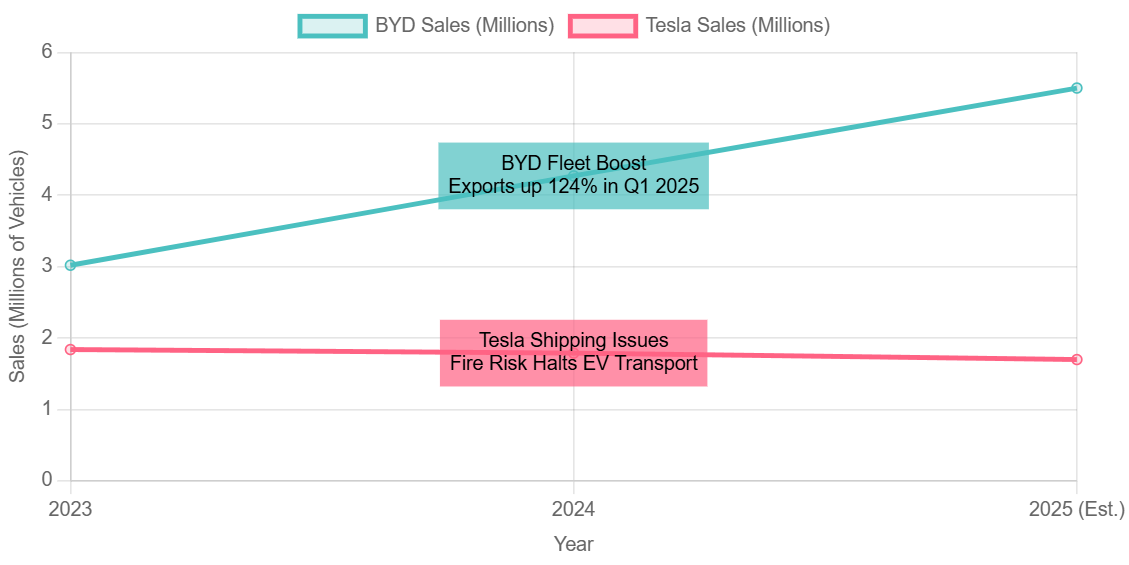
While established shipping lines grapple with EV fire risks, BYD has taken an unprecedented gamble on maritime transport as core strategy. The Chinese automaker has constructed seven car carriers since 2022, with plans to launch up to 14 vessels by 2026. The fleet includes the world's largest car carrier, the BYD Shenzhen, with capacity for 9,200 vehicles per voyage.
This vertical integration grants BYD unprecedented control over its supply chain while exposing the company to maritime risks traditional automakers avoid by using third-party carriers. BYD invested $687 million to build its own fleet as third-party shipping costs skyrocketed, with daily charter rates hitting $150,000 per vessel in 2024. Ships like the BYD Shenzhen, BYD Changzhou, and BYD Explorer No. 1 complete regular shuttles between Chinese factories and global ports, carrying tens of thousands of the company's own vehicles per voyage.
The strategy enabled BYD's export surge. The company exported over 1.5 million vehicles in 2024, capturing significant global EV market share. Export revenues exceeded domestic sales in key quarters as BYD penetrated markets from Europe to Latin America.
But BYD's fleet faces the same fundamental physics as every other carrier. Lithium iron phosphate batteries used in BYD vehicles may resist thermal runaway better than other chemistries, but they still burn when failures occur. The company's ships pack thousands of battery-powered vehicles into confined spaces optimized for economic efficiency, not fire safety.
The Morning Midas fire demonstrates vulnerability even in state-of-the-art car carriers. No ship design can contain battery fires involving hundreds of vehicles. When thermal runaway begins, evacuation becomes the only option.
The Insurance Reckoning
Matson suspended all electric and plug-in hybrid vehicle shipments across its network, citing lithium-ion battery fire risks. This decision by one of the Pacific's largest shipping operators reflects insurance industry pressure following mounting losses from EV cargo fires.
War risk premiums have increased dramatically. Some insurers now charge substantially higher rates for policies covering dangerous routes. But EV cargo creates risks that transcend route geography. Battery fires can occur anywhere, triggered by manufacturing defects or minor damage invisible during loading.
Allianz Commercial, one of the world's largest marine insurers, reported that RoRo ships now generate disproportionate fire claims despite representing a small fraction of the global fleet. The company implemented new conditions requiring maximum 30% battery charge states for transported EVs and additional spacing between vehicles. These requirements significantly increase shipping costs and reduce cargo capacity.
Lloyd's of London syndicates are developing EV-specific exclusions and premium calculations. Calculations now factor battery chemistry, charge state, and vehicle age. Some underwriters require separate fire suppression systems for EV cargo: installations costing millions per vessel that still cannot guarantee containment.
The insurance industry's response creates feedback loops. Higher premiums increase shipping costs, forcing automakers to raise prices or reduce margins. Shipping suspensions delay deliveries and disrupt supply chains. Alternative routes through insurers willing to cover EV cargo command premium rates that can double transportation costs.
Regulatory Paralysis
The International Maritime Organization (IMO), shipping's global regulatory body, faces unprecedented challenges addressing EV fire risks. Traditional dangerous goods classifications don't apply to consumer vehicles, even those containing large battery systems. Existing fire safety regulations assume fires that crews can fight and contain, not self-sustaining chemical reactions that resist all suppression efforts.
The IMO approved net-zero shipping regulations in 2025, focusing on emissions reduction and fuel standards. EV cargo safety remains largely unaddressed. Draft regulations under development include requirements for battery charge limits, enhanced fire detection systems, and improved crew training. Implementation remains years away.
National maritime authorities struggle with similar gaps. The U.S. Coast Guard's investigation of the Morning Midas fire focuses on crew evacuation procedures and emergency response rather than prevention of battery-related incidents. European regulators examining the Fremantle Highway disaster emphasize port fire response instead of shipboard fire prevention.
Regulatory lag occurs partly because EV fires represent genuinely new phenomena. Traditional maritime fire safety developed around wood, coal, oil, and chemical cargoes with well-understood combustion properties. Lithium-ion thermal runaway behaves differently than any previously transported material.
Bureaucratic inertia also plays a role. Maritime regulations change slowly through consensus-building processes involving dozens of nations with competing economic interests. Meanwhile, EV exports continue growing exponentially. China alone shipped over 3 million electric vehicles annually by 2025.
The Tesla Calculation
Tesla faces strategic disadvantage in the new maritime risk environment despite its EV leadership. Unlike BYD's integrated shipping operations, Tesla depends on third-party carriers that increasingly view EV cargo as unacceptable risk.
Matson's suspension of electric vehicle shipments directly impacts Tesla's Pacific routes. The company must seek alternative carriers willing to transport battery-powered vehicles. These alternatives typically charge premium rates and impose restrictions that increase costs and complexity.
Tesla's high-value vehicles create additional insurance challenges. A single Model S Plaid costs more than most combustion engine cars. Smaller fires can generate larger claims. Tesla's direct sales model means the company bears full financial risk for vehicles lost in transit, unlike traditional automakers who transfer risk to dealers or distributors.
The company's response reflects these constraints. Tesla has quietly begun requiring lower battery charge states for transported vehicles and investing in alternative shipping arrangements. But fundamental physics limits available solutions. Tesla vehicles contain large lithium-ion battery packs that will burn if thermal runaway occurs, regardless of shipping methods or charge states.
Tesla's technology leadership in areas like autonomous driving and over-the-air updates provides no advantage in addressing maritime fire risks. Battery chemistry and thermal management remain largely outside the company's control once vehicles leave the factory.
Environmental Contradictions
EV shipping fires expose contradictions in electric vehicle marketing. Cars marketed as climate solutions become sources of toxic pollution when they burn at sea.
Lithium-ion battery fires release hydrogen fluoride, carbon monoxide, and other toxic gases that can poison marine ecosystems over vast areas. When ships sink, battery chemicals and heavy metals contaminate ocean floor sediments for decades. The Felicity Ace released an estimated 1,000 tons of toxic materials into the Atlantic when it sank in 2022.
Single shipping incidents can generate more immediate environmental damage than the lifetime emissions of hundreds of combustion engine vehicles. Yet environmental impact assessments for EV deployment rarely account for maritime transport risks or fire-related pollution.
The contradiction extends to carbon accounting. EV life-cycle assessments assume orderly recycling of battery materials at end-of-life. Vehicles that burn at sea and sink to ocean floors represent complete loss of embedded energy and materials. No recycling recovery becomes possible.
Climate advocates promoting rapid EV adoption to reduce transportation emissions rarely acknowledge that accelerated deployment increases maritime fire risks and associated environmental damage. The rush to electrify transportation creates new forms of pollution that existing environmental frameworks don't capture.
Supply Chain Fragility
EV shipping fires reveal deeper fragility in globalized supply chains optimized for efficiency rather than resilience. Automakers pursuing lowest-cost transportation find themselves dependent on shipping networks unprepared for battery cargo risks.
The concentration of EV manufacturing in China amplifies these vulnerabilities. Over 60% of global EV production occurs within a few hundred miles of Chinese ports. This creates massive volumes of battery cargo moving through chokepoints in the South China Sea and Pacific shipping lanes.
A single major incident could disrupt global EV supply chains for months. Consider a fire involving multiple vessels or blocking a key port. The Morning Midas fire, involving just one ship, triggered shipping suspensions across multiple carriers and routes.
Port facilities face similar exposure. EV cargo fires at terminals can spread to adjacent vehicles and infrastructure, as demonstrated by smaller incidents at ports worldwide. Most terminals lack firefighting equipment designed for battery fires or storage areas that can contain thermal runaway incidents.
The fragility extends to rescue operations. Ships burning in remote ocean areas cannot receive external firefighting assistance. Coast Guard vessels and aircraft can evacuate crews but cannot extinguish battery fires or prevent environmental damage from sinking vessels.
Technology Response
Battery manufacturers and shipping companies are developing technologies to address EV fire risks. Solutions remain years from deployment at scale.
Solid-state batteries promise reduced fire risk by eliminating flammable liquid electrolytes. Mass production remains elusive despite decades of research investment. Lithium iron phosphate (LFP) batteries used in lower-cost EVs show less tendency toward thermal runaway but still burn when failures occur.
Ship design innovations include enhanced fire suppression systems, compartmentalization to limit fire spread, and improved detection systems. These modifications cost millions per vessel. They cannot eliminate risks from large battery fires that overwhelm any suppression system.
Alternative transport methods face insurmountable limitations. Rail, truck, and air freight cannot handle volumes required for global EV trade. Maritime shipping remains the only economically viable option for intercontinental vehicle transport, regardless of fire risks.
Some manufacturers explore "battery-free" shipping: removing battery packs for separate transport and installing them at destination ports. This approach eliminates thermal runaway risks but requires significant investment in pack removal and installation equipment. New logistical complexities emerge.
Future Scenarios
Three potential trajectories exist for EV maritime transport:
Continued Crisis: Fire incidents increase as EV volumes grow faster than safety improvements. Major shipping lines exit the EV market, creating capacity shortages and higher costs. A catastrophic fire involving thousands of vehicles or multiple ships triggers global shipping restrictions.
Managed Risk: Industry develops effective fire suppression technologies and regulatory frameworks. Higher safety standards increase shipping costs but enable continued growth. EV fires become manageable incidents rather than total losses.
Modal Shift: Maritime risks force fundamental changes in EV supply chains. Manufacturing relocates closer to end markets, reducing long-distance shipping requirements. Alternative transport methods handle remaining intercontinental movements despite higher costs.
The chosen path depends on technological breakthroughs, regulatory responses, and industry willingness to accept higher costs for improved safety. Current trends suggest continued crisis unless major innovations emerge in battery chemistry or fire suppression technology.
Conclusion
The electric vehicle revolution promised cleaner transportation through technological innovation. Yet the physics of lithium-ion batteries created new forms of risk that existing maritime infrastructure cannot handle.
EV shipping fires represent more than isolated incidents. They reveal fundamental tensions between rapid technological deployment and system safety. The same battery technologies that enable zero-emission transportation become uncontrollable hazards when confined in ship cargo holds.
Supply chains optimized for economic efficiency prove unable to manage the unique risks of battery cargo. Regulatory frameworks designed for traditional goods cannot address the novel hazards of thermal runaway. Insurance markets struggle to price risks that fundamentally differ from historical maritime perils.
The gap between EV marketing narratives and maritime realities will widen as production scales increase. Unless breakthrough technologies eliminate battery fire risks or revolutionary approaches to maritime transport emerge, the electric vehicle revolution will continue rewriting the rules of risk at sea.
When the Morning Midas burned, it illuminated a contradiction at the heart of the clean transportation transition. The journey toward sustainable mobility creates its own forms of environmental and economic destruction. Whether the industry can navigate these contradictions will determine not just the future of electric vehicles, but the viability of global supply chains built around battery technologies.
The ocean burns differently than the land. At sea, there are no fire departments, no evacuation routes, no second chances. Only physics, chemistry, and the vast indifference of open water confront human technological ambition.
Water cannot extinguish what burns from within. The Morning Midas proved this lesson at a cost measured not just in dollars, but in the recognition that clean technology carries dirty secrets beneath the waves.