

You Cannot Eat Sanctions
The inputs of Western food production, the restrictions the West has placed on those inputs, and the arithmetic that follows
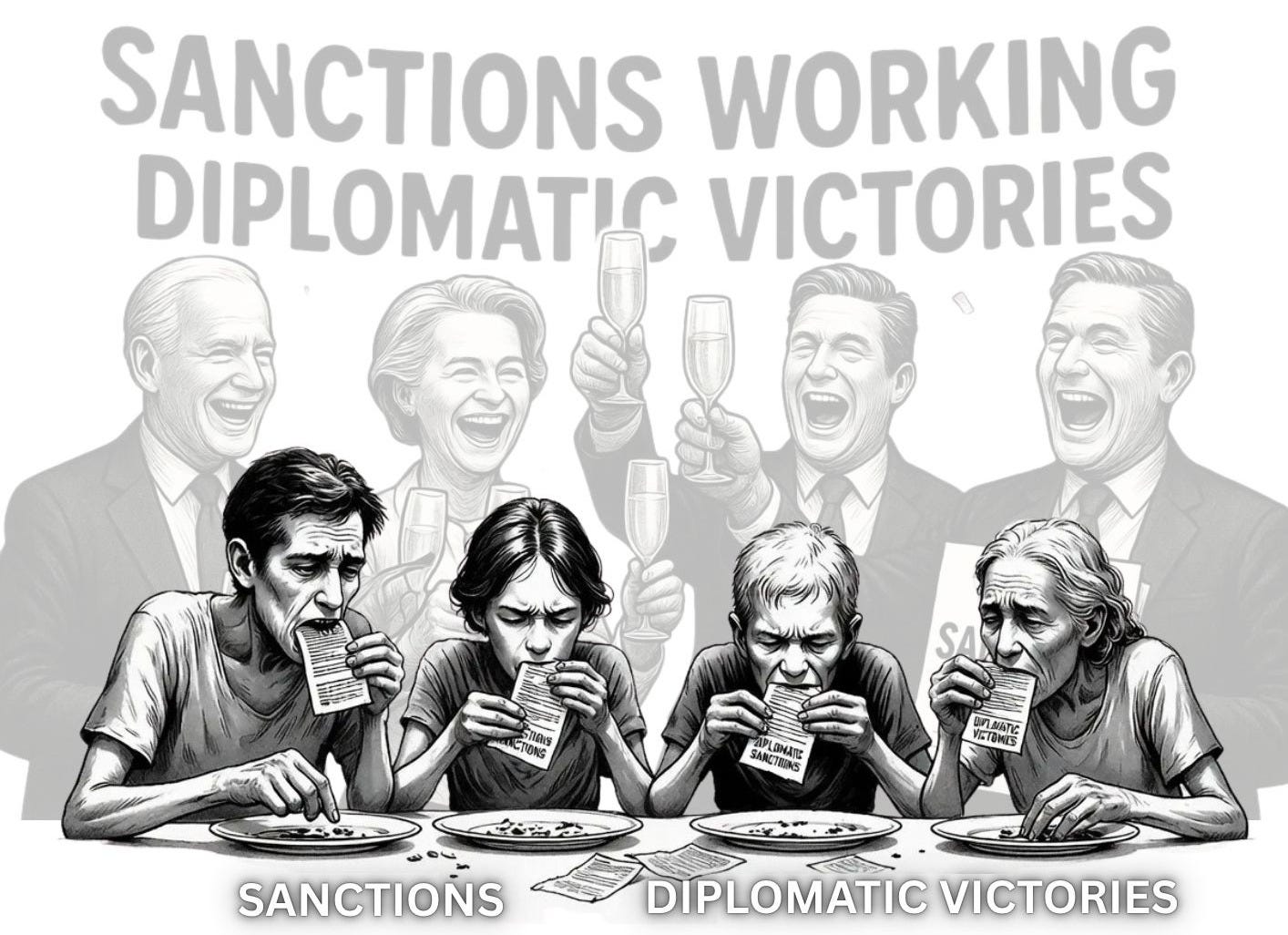
The evidence has been available for years. This report assembles it in one place.
Sanctions are a diplomatic tool. Food is a biological requirement.
The first can be imposed by governments.
The second cannot be produced by governments.
Governments can only subsidise, restrict, or redirect the inputs that agriculture requires.
When those inputs have themselves been restricted by the same governments, the inputs do not arrive, the food does not get produced, and the population does not get fed.
Everything in this report follows from that sentence.
Input Chain
Agriculture in America, the UK, Ireland, and Europe operates on a defined set of industrial inputs. Remove any of them and yield falls.
Remove several and the operation ceases to be commercially viable.
Nitrogen fertilizer. Produced from ammonia. Ammonia produced from natural gas. No substitute at scale.
Phosphorus fertilizer. Produced from mined rock phosphate. A small number of countries control the majority of global reserves.
Potassium fertilizer. Produced from potash.
Russia and Belarus together account for a dominant share of global exports.
Diesel. Powers every tractor, combine harvester, grain dryer, and transport vehicle on every farm in the West. When the diesel stops, the farm stops.
Machinery parts. Agricultural equipment supply chains run through China, Russia, and Ukraine. Bearings, hydraulic components, and specialised steel move along routes that war and sanction have disrupted.
Seed and genetics. A smaller dependency but an increasing one as proprietary seed stock concentrates.
Agricultural labour. A dependency that has been declining across the West for decades and is not replaceable at the volumes required.
Every item on this list has been documented as critical to Western food production by the sector itself, in industry reports and government assessments available in every affected jurisdiction.
Sanctions Architecture
Beginning in 2022 and intensifying through 2023, 2024, and 2025, the West imposed economic restrictions on Russia and Belarus. The measures evolved in scope and severity. The following restrictions directly intersect the agricultural input chain documented above.
Natural gas imports from Russia. Restricted, then phased out, with the final European pipeline-gas volumes and Russian liquefied natural gas covered by the EU ban deadline of 25 April 2026.
In 8 days time.
Article 122 exists to stop it.
I have sent the reports to 515 MEP’S and heard nothing.
Russian fertilizer exports. Subject to formal restrictions and to informal constraints through shipping and insurance channels. Volumes to Europe fell sharply from pre-war baseline.
Belarusian potash. Sanctioned following the 2020 political crisis in Belarus, with additional restrictions added from 2022.
Russian oil. Price cap and volume restrictions imposed by the G7 and adopted by the EU. Diesel produced from Russian-origin crude fell under corresponding secondary restrictions.
Russian banking infrastructure. SWIFT disconnection of major Russian banks, with consequences for payment in any remaining trade.
Each of these restrictions had a stated diplomatic purpose. Each was imposed by the governments of the same populations that depend on the agricultural inputs these restrictions constrain.
The Collision
Sanctions intended to raise the cost of Russian foreign policy raised, by the same mechanism, the cost of European and North American food production. Causation is direct. A single step connects the sanction to the agricultural cost.
Natural gas restrictions raised natural gas prices. Ammonia producers operating on natural gas feedstock saw input costs multiply. European nitrogen fertilizer plants shut down, reduced output, or passed the cost through. European farmers paid more for nitrogen or applied less of it.
Potash restrictions reduced available supply. Prices rose. Farms operating on thin margins reduced application rates. Soil potassium levels draw down across a single growing cycle, and the deficit appears in yield one to two seasons later.
Diesel cost increases raised the operating cost of every farm activity, from tillage to harvest to delivery. Farms already carrying high debt loads reached the point where the next season could not be financed.
Banking sanctions disrupted payment for any fertilizer or machinery still available through Russian channels. Even where product could be sourced, it could not be paid for.
This sequence is not a prediction. It has been running for four years. Documentation exists in industry association reports, farm bankruptcy filings, fertilizer producer earnings statements, and agricultural ministry publications in every affected country.
The Delay
Political usefulness of sanctions rests in part on the gap between imposition and effect. A government that imposes a sanction in year one can claim success in year one. The agricultural consequences arrive in year three and compound in years four and five.
Delay is built into the agricultural cycle. Farmers use stored fertilizer and stored seed in the first year after a price shock. In the second year they reduce application, switch to cheaper alternatives, or plant lower-input crops. In the third year soil fertility declines become visible in yield. In the fourth year financial stress reaches the threshold of farm exit. Food prices rise through all four years, and supply constraints begin to appear in the fourth and fifth.
The West is now four years into the original 2022 architecture and one to two years into the tightenings of 2024 and 2025. The visible effects of the first phase are arriving. The effects of the later phases are ahead.
Political Denial
An institutional apparatus that imposed the sanctions cannot now acknowledge the causation. To do so would be to admit that the diplomatic tool chosen has inflicted measurable harm on the population the institution serves. The institutional response has been to fragment the evidence. Farm debt is presented as a farming problem. Fertilizer costs are presented as a commodity problem. Grocery prices are presented as a supply chain problem. Crop yield declines are presented as a climate problem.
Each fragment is handled separately. The common cause is not named.
Media coverage follows the institutional frame.
A story about a farm bankruptcy does not mention potash sanctions.
A story about grocery inflation does not mention natural gas restrictions.
A story about fertilizer prices does not mention Belarusian sanctions. Fragments remain fragments. The reader cannot assemble the picture because the picture is never assembled.
An earlier report in this series documented the channel through which an outside researcher might have assembled that picture for the institutions themselves and found the channel closed. The two findings are related. Institutions that cannot receive external synthesis cannot be shown their own evidence, even when the evidence concerns the food supply of the populations those institutions claim to serve.
Calorie Math
Populations require calories daily. Calories come from agricultural output. Agricultural output depends on the input chain described above.
The chain has been disrupted by the sanctioning parties themselves.
Arithmetic runs as follows. If the cost of nitrogen, potash, diesel, and machinery has risen substantially, if farmer debt has risen to crisis levels, if application rates have declined, and if acreage has contracted, then output falls. When output falls below domestic consumption, imports make the difference. When global prices rise simultaneously because the same inputs are constrained worldwide, imports become expensive.
When imports become unaffordable or unavailable, the deficit is measured in calories that the population does not consume.
Sanctions produce no calories. Diplomatic victories produce no calories. Press releases produce no calories. The population eats what the agriculture produces. The agriculture is producing less because the inputs cost more and arrive in smaller volumes. No forecast is involved. This is the state of the system as of spring 2026.
Closing
Evidence has been available throughout. Farm bankruptcy filings are public. Fertilizer price data is public. Natural gas contract terms are public. Sanctions legislation is public. Agricultural output statistics are public.
What has been absent is the assembly. Each data point sits in its domain. Each domain reports its fragment. The full picture requires crossing domains that institutional structures do not cross, and that institutional inbound channels will not receive when anyone outside the institutions attempts to provide the crossing.
Citizens of the sanctioning countries were not asked whether they preferred the diplomatic outcome to the agricultural one.
They were told that the diplomatic outcome was necessary and that the agricultural consequences were someone else’s doing.
The first half of that message was assertion. The second half was false.
Sanctions cannot be eaten.
The populations of America, the UK, Ireland, and Europe cannot eat the diplomatic victories their governments claim.
They will eat what their agriculture produces, and their agriculture is producing less, for reasons their governments are unwilling to name.
The calorie deficit does not care about the political purpose of the sanctions that caused it.